
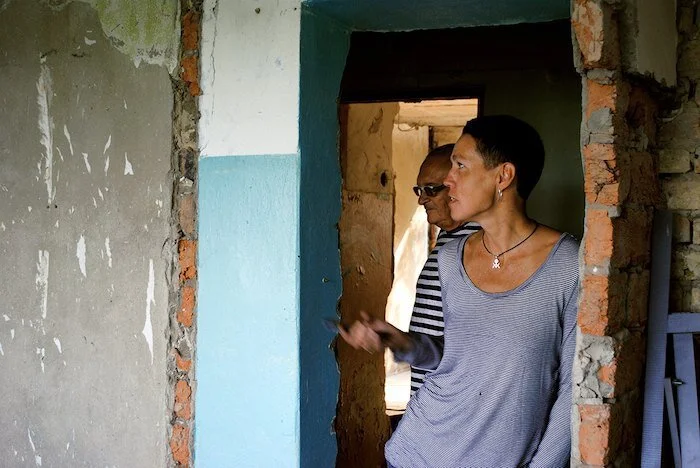
Polina Limina: At first glance, your initial theme — “Valuable Things” — was evenly split into two aspects. Yes, Vlado, in the series “Zone of Silence” you cut the human body from the inside, cut it into many pieces - as if you were showing the anti-human influence of a number of values on human existence, both individual and shared. The body becomes meat, a material that can be deformed to the extent that a certain ideology requires it. The conditional “valuable thing” appears as a foreign object that penetrates and destroys this body (more precisely, its fragment). And in the series of Vladimir “Inscription” values acquire an external, rather changeable form.
Vlada Ralko:You have surprisingly accurately grasped the essential collision of external and internal, on which Vladimir and I have focused in our projects. But as we each worked on our line, the apparent simplicity of the superiority of inner will over external coercion quickly began to dissolve under the onset of new complications. The problem is that neither work nor activity are suitable for defining the artist's actions. It was because of the difficulty of identifying such a word, which would more or less accurately outline the meaning of the existence of an artistic thing, that we focused on our own work process. Usually this is an internal affair, hidden from prying eyes, which is also called the “kitchen”.
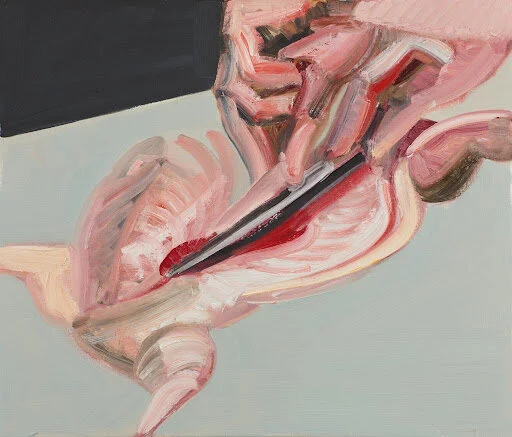
By the way, I did not think about this name when I was preparing to perform a kind of work duty in the form of forty images related to cooking. Instead, we both pondered all the time about what exactly points to the anti-human nature of Soviet-era commissioned art, which is called socialist realism. The adjectives “socialist” or “Soviet”, added to the basic concepts, have in some radical way turned them upside down. Because of this, already now, in the post-Soviet sphere, the train of distortion of the essence, which stretches behind the Soviet interpretation of valuable things, provokes irony to be separated from them. The suggestion to mention universal values becomes obscene and is subject to sustained resistance in the form of silence or formal refusals. Values begin to be something abstract or something that is in a parallel space and has no direct relationship to real life. For its part, being without value needs slips into everyday violence, not recognized as such due to its banality. Everything is like in the kitchen — daily activities have the appearance of suffering that can no longer suffer, but still retains the shape of the body or reminds of it. In general, suffering is also no longer embarrassing, because it is perceived as a boring necessity.
P. L.: Even in our previous conversation, I was interested in your thesis about the obscenity of serious conversations about universal values. According to my observations, irony (or, in some cases, cynicism) is often used in order not to appear naive in a certain matter, to add complexity to the initial simplicity. How do you personally deal with this sense of obscenity of having a frank conversation about values?
IN. RIVER:In the beginning, I do not know for sure how I will speak about them, while cynicism and irony are just meant for predictable responses. You yourself began the conversation by using the concept of a valuable thing in the sense of an ideological manipulative tool that, as you aptly observed, destroys the human. But in order to oppose you, proving that freedom, equality, fraternity, justice, love are the opposite, namely, the kind without which life is impossible, but there is only the present duty of life, I must find a form that will be the only correct one and will be able to keep what has been said. This process has nothing to do with honesty, because my own experience will never be enough reason for you to believe me. In fact, you should not believe me; rather, what I say should direct you to yourself. Therefore, I will never speak straightforward—primary simplicity has nothing to do with directness, and the road to it goes through a dark forest.
P. L.:The same values in Vladimir's project are randomly fixed on the chalkboard in order to be erased later, and new ones will necessarily appear on top of the previous rules and formulas - “the holy place will not be empty.” The inscriptions appear to be differentiated, and they can fit into a single system only under one condition - the imposition of the viewer's own experience of the educational process, which sometimes is closer to the manifestation of power and punishment than to individual development and thirst for knowledge.
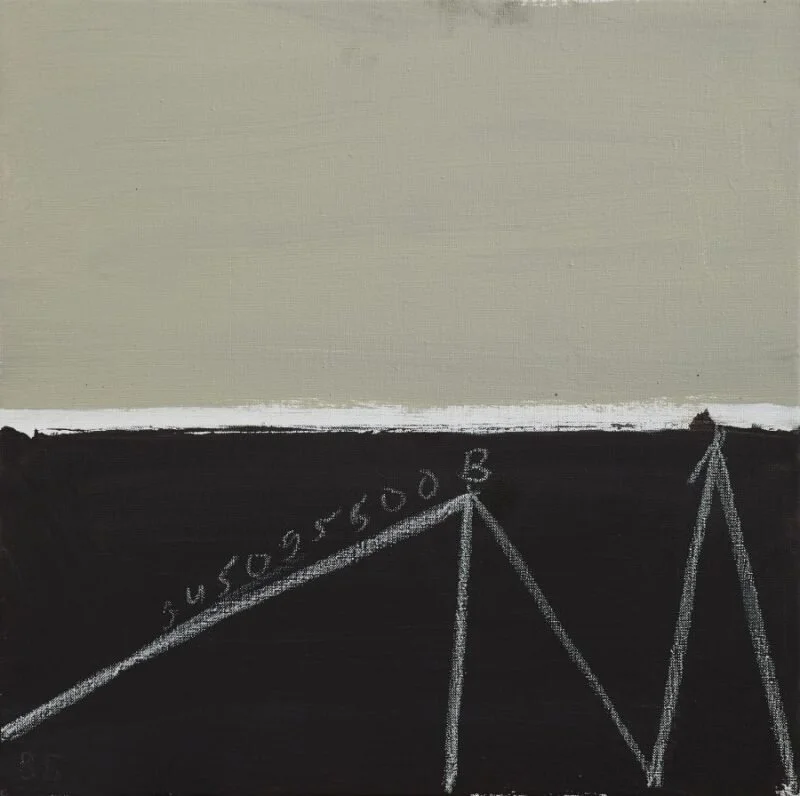
Vladimir Budnikov:The word “educational”, as you have used it now, refers to the illumination of things, to an enlightening approach in understanding values, namely, to their indivisible nature. Often we are faced with the practice of dividing statements into content and quality, where quality is usually understood as a separate decorative feature. Because of this, language ceases to exist as such, turning into information. While working, I was engaged in translating combinations of letters, words and sentences into pictures, so, in essence, this process became a culling of what was spoken, namely a certain collection of “what” and “how”, looking at sentences as a thing.
You have quite accurately observed that the concept of education as the presence of light for the detection of things is replaced in time by the educational process in the form of the imposition of a set of stable rules. In this way, an inscription that aims to embody an idea and clarify an idea risks becoming an prescription, imposed from the outside by a compulsion to think in a certain, determined way by someone. The totalitarian understanding of art involves the artist performing a task according to a predetermined plan. That is, the clarity of the beginning and end points of the process seems to set strict limits for its course, rejecting the possibility of doubt, uncertain wandering, lightning change of intention. Ultimately, the artistic process takes on the traits of a controlled mechanism, a system where the irrationality of the human becomes an unnecessary, painful and unreliable whim. In contrast, I discover the entire contradictory flow of the process as the most vulnerable link between the two mysteries of the original idea and the finished work.
P. L.: What kind of inscriptions did you take as a basis? I see a lot of quotes that are hard to read. Does it matter to you what exactly is written there, is the fact of the presence of the inscription sufficient?
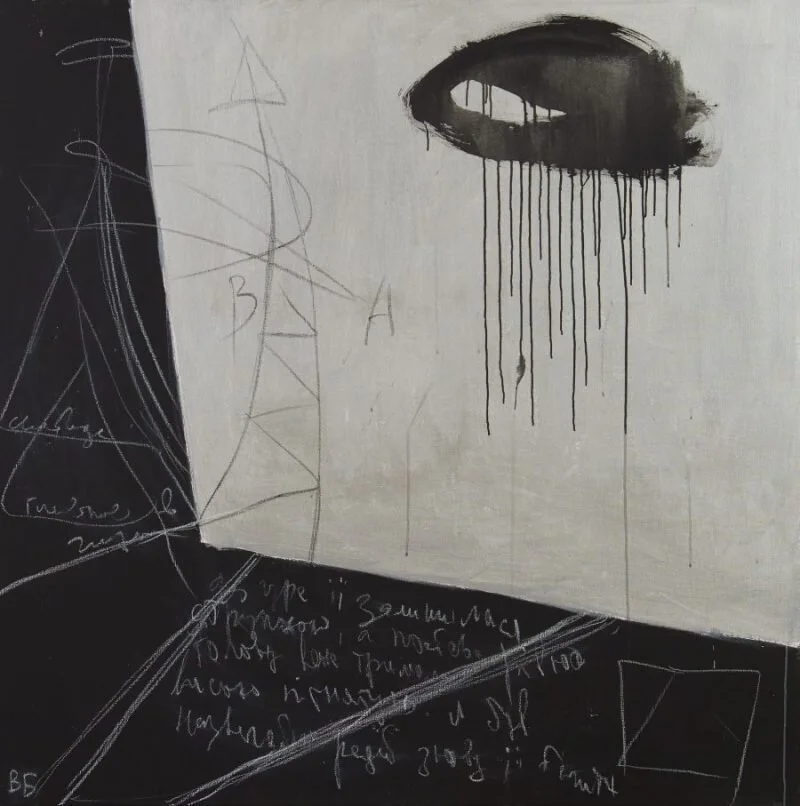
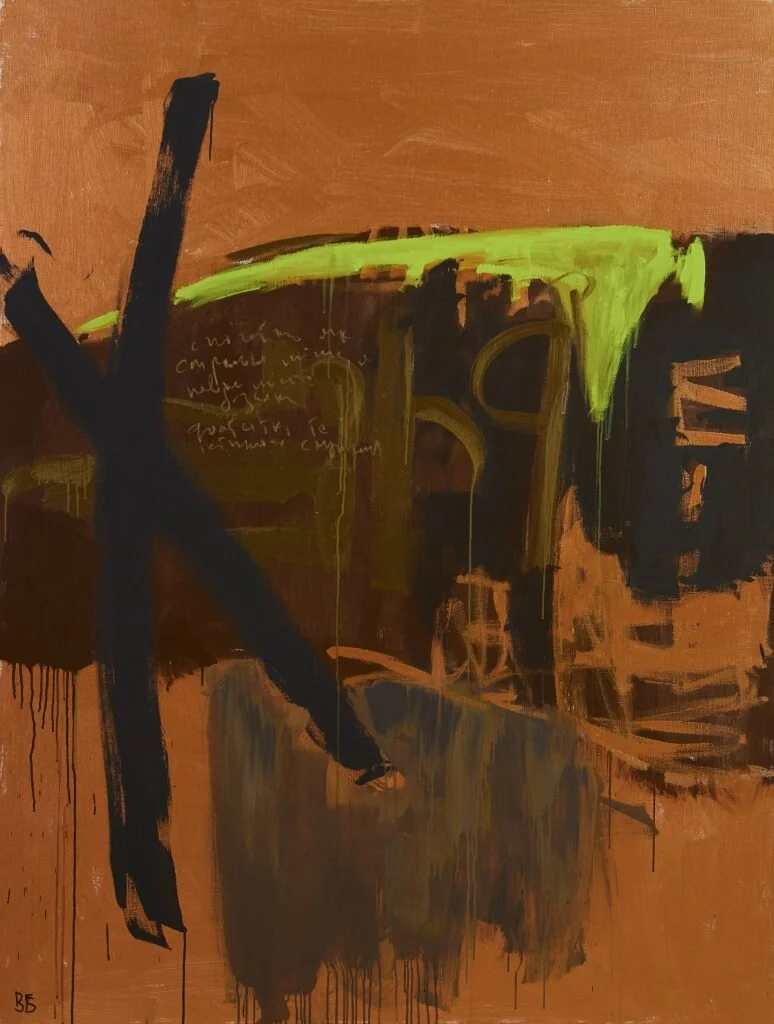
IN. B.: In my works, I have transformed the inscriptions into visual interpretations of their reading. Written in this way became a drawing fundamentally removed from the narrative zone. Quotes and individual words should not be read. But this is by no means an encryption — I see in this writing something fundamentally opposed to a verbal message. Rather, the fact of the presence of speech as handwriting, gesture, which come to the fore and by their intimate, individual nature negate any established rule of writing, is important here. Written language is reinvented every time. Each work is articulated openly — everywhere you can see calculations, snippets of drawings, something similar to formulas or “automatic drawing”, when the hand unconsciously reproduces movements during reasoning or conversation. The language seems to be continuously checked by writing, when doubt or coincidence does not allow the planned version to be realized. At the same time, such movements are correlated with musical vibrations of sound and possibly singing, when the voice absorbs the meaning of words.
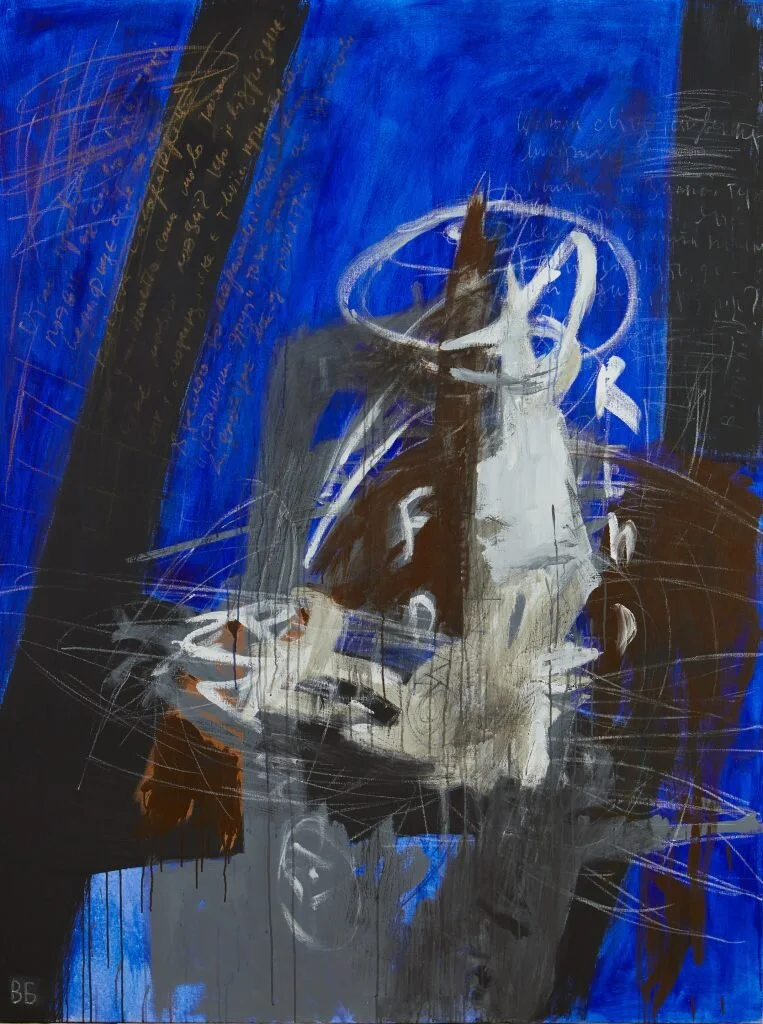
P. L.: And by what principle are the colors introduced to this relatively monochrome series?
IN. B.: I used blue, gold and silver paint as an element of material background. They in these works are something like the sky and are solid according to the canonical convention of their image in the icon. At the same time, the presence of these colors was necessary for me to express depth, perspective. The inscriptions are layered one on top of the other, but between them there is not only time, but also air, space.
P. L.: Among the variations of symbols, my attention was primarily drawn to the outlines of the cross and pedestals, which appear on several works. The concept of “Valuable Things” traced the themes of Kanev and the figure of Taras Shevchenko — is there a connection?
IN. B.: Images similar to the symbols you refer to refer rather to the formation of a coordinate system that transforms the black background from a school slate into a deep space of darkness. The concept of a coordinate system is also used in cases where we are talking about the limits of civilized choice. All would be well if it were not for the word “system”, the presence of which means that immediately after the discovery, study and classification of values, the coordinate grid becomes a lattice and begins to forcibly hold the values of valuable things inside its cage. Kaniv is also forcibly transformed into a kind of “grates” for the figure of Shevchenko, where the poet's image approved by the system of understanding is fought with special perseverance. I deliberately do not determine by what kind of system, because on Mount Chernecy there was a reconciliation of the figure of the poet, adapted to the colonial realities of Soviet Ukraine, with his image embedded in the official pantheon of heroes of the Independence era. In both cases, Shevchenko's rebellious, contradictory spirit is brutally pacified, and it is this pacification that acts as strict censorship.
However, we live in a day when the terms defining value concepts have long since moved off their pedestals, shuffled, changed places. In the Inscription works, I also confuse and superimpose some drawings on others, and I turn coordinate systems into abstract drawings, which by their very appearance negate what is imagined as “correct”. That is, it was interesting for me to observe how each touch or movement of the brush becomes an inscription that may not illuminate something else, but become light itself. In this case, my inscriptions are independent and integral, unlike descriptions that are conditioned by their subjects.
P. L.: I see in this the search for an answer to the question: can inscriptions become the light [of knowledge] if they do not contain a semantic component? Traditionally, “enlightenment” tends to a rational, even somewhat mechanized knowledge of the world: a layering of facts, events, ideas. As I understand now, your inscriptions are close in meaning to the sphere of the sensual and spiritual. That is, it is the light of the possibility of knowledge, the possibility of speech. It is very close to Heidegger's philosophy. So far, I have calculated the three main components that you highlight in the speech construct: inscription, prescription, and description. The first appears primary and universal, the next two are derivative and variable. Are there any other basic concepts in your understanding of the structure of the “ideal” language that you used while working on the “Inscription” series?
IN. B.: I insist on understanding the language through the speech of the artist, where I use the word “artist” in a very broad sense, which in this project goes all the way to the famous boyish definition. Your reasoning about the possibility of language is perfectly valid, because it refers to the humanism that Boyce's statement is full of, which has unfortunately turned into a meme with a distorted meaning. In my opinion, Boyce meant precisely the possibility of any person's involvement in the artistic cause, about the universal universal optics of which we have already talked a lot. But this probability of involvement is vulgarized because of its widespread interpretation as a completed fact.

I consider the inscription to be that first gesture, which is at the same time an intention, an action and a language. However, speech continuously speaks to itself. Elfrida Elinek said she wanted to catch the language on the word. Perhaps one of my main tasks is the constant clarification of what language is in general. So I hint at possible pitfalls, like: the prescription is repressive, the description is pornographic. Language cannot be perfect, because a living and complex person who constantly threatens himself is a language because he represents himself in speech. Language is a risk, unlike rational cognition, it does not develop gradually. In fact, the language may not exist — it may not come true.
P. L.: In fact, all the elements of the “Inscription” are a reference to recognizable images of everyday life. It seems to me that they should instill in the viewer a chain of associations, which will eventually lead to the formation of new meanings. If we talk about your latest projects, similar inscriptions and drawings have already appeared in the “Flight” - there they cited the documentation of aircraft equipment. Now, instead, symbols make me recall not only mathematical formulas or excerpts from school literature works, but also inscriptions in public places (dressing rooms, building walls, monuments, etc.).
IN. B.: Some of the works undoubtedly have something in common with spontaneous graffiti, namely a non-verbal manifestation that cannot be read based on the sequential composition of letters into words. Unreadability becomes a challenge and at once exposes the ultimate vulnerability, in which protest grows into a cry that is left alone and sounds from nowhere. But this is where the similarity ends, because instead of the plane of the wall, I create a three-dimensional space from the inscriptions. The overlay of inscriptions forms optics when it is as if it is possible to enter what is written and move between letters, lines, formulas and blanks.
P. L.: But when I looked at the author's titles for the series, I had a desire to structure the works according to the principle “First there was the Word”: from the stage of desire and desire (“intention”) I moved to the direct embodiment of the word (“inscriptions”), its promulgation (“manifestations”) and the acquisition of human character (“speech”, “goal”, “message”, “exclamation”, etc.). A kind of life cycle of vocabulary, where the last stage — consumption — is given to the viewer, and the artist plays the role of a demiurge. Similar processes can be seen in the formation of ideologies. In the course of your work, how have you seen/explored these cycles of value development: from emergence at the level of values to implementation in people's lives at the everyday level?
IN. RIVER: Even at the beginning of the conversation, Vladimir equated the word and the thing. Because this apparent unity resides simply on the surface of the tongue (“recti?” is synonymous with “say” and has a common root with “thing”), speech cannot be distributed in the cycle stage. Rather, it is alive and full of meaning when it is all at once, but in the process it sometimes begins to turn and show itself from sides that were previously invisible through perspective. It seems to me that the names, in fact, delineate a certain spatiality of the whole series, because they are not phases, but sides. In the works of the project, it is impossible to return to individual words again, to divide — this is a particularly precise definition of language in the sense of its absolute conformity to the human being. Ideology, on the contrary, prepares language as a body that will no longer be alive, because you yourself pointed out that it is based on similarity instead of essence.
In my last text for the “Zone of Silence” project, I mention Faust's hesitation in translating the Bible line, the passage from which you quote, where he cannot make a final choice between Word and Thought and finally rests on the primacy of the Cause. The work of an artist is also not a work in the usual sense, but rather a thing that he is passionate about. Such admiration, as a mutual process of mutual influences, removes the human from the routine. Also, it is in a state of enthusiasm that it is possible to acquire valuable things for oneself in contrast to the situation when ideology imposes values from the outside. The fact is that a person is capable of doing something exclusively on his own, because he cannot be forced to love, to be free, or to believe in equality.
Vladimir's “inscription” is an action, or better, a verb. Like Faust, Budnikov denies a word that is separate from the case. In this sense, the idea of bringing values into life as rules seems absurd because values do not survive in the mode of household precepts — they are effective only when they capture, become a Work, not a duty.
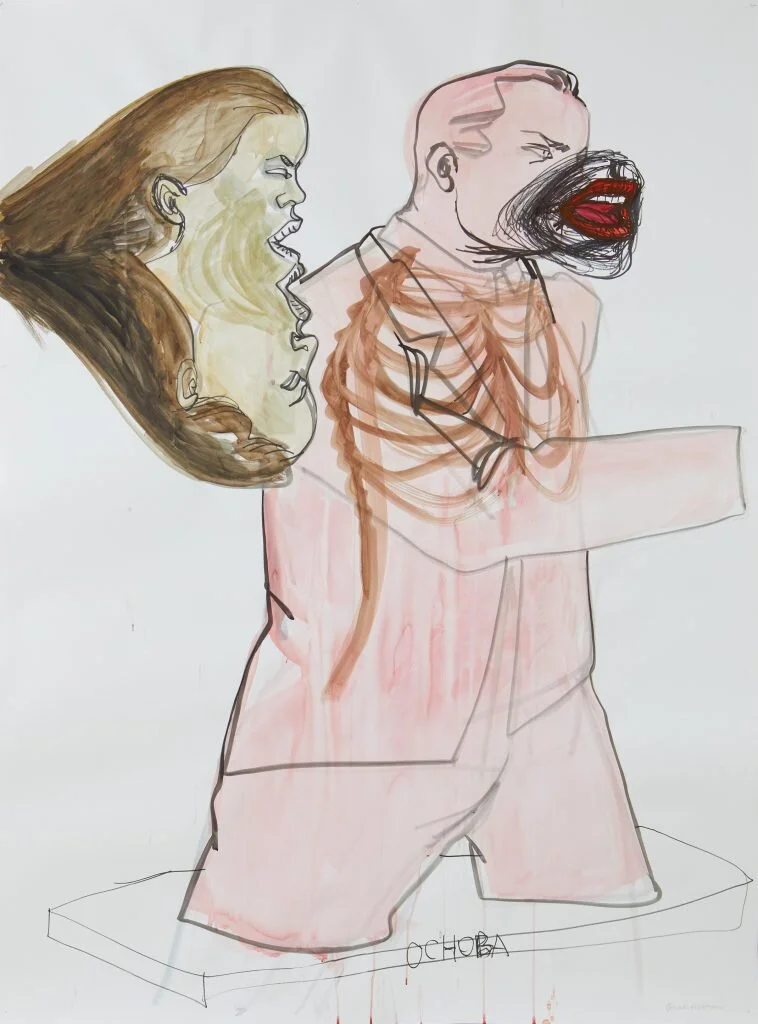
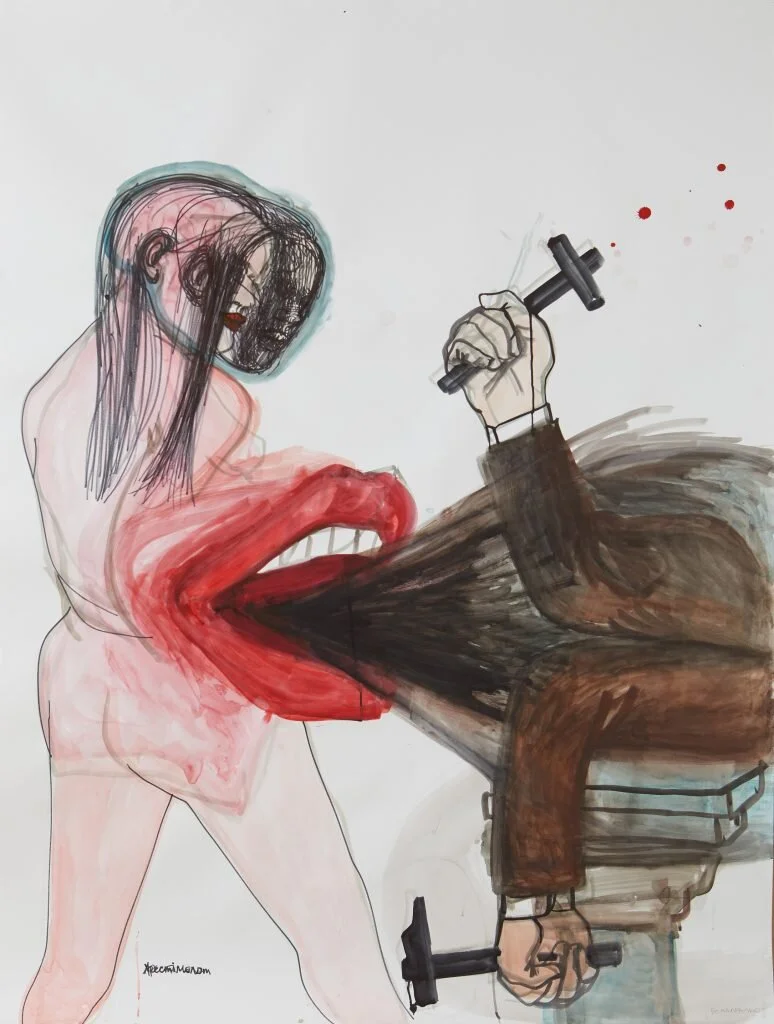
P. L.: Vlado, let's go back to your series “Zone of Silence”. Here, twins constantly occur, mirroring similar phenomena: “Cross and hammer”, “Sickle and mouth”, “Faith and work”, duplicated two-fingers and human heads. And in the work with the signature “Basis” you demonstrate the framework of honoring the individual as a “valuable thing”. Have you set yourself the goal through these comparisons and clashes to reach an understanding of the deep essence of the ideologies that hide under the external form? If so, what conclusions did you come to during the work?
IN. RIVER: The fact is that the introduction of value into everyday life in the form of a rule is impossible: value becomes something like what it was, and immediately becomes part of the mechanism of ideological coercion. It loses something fundamentally human that does not survive amid the constraints of ideology. Hence the series of doublings or combinations of ideological symbols in my works. By the way, I combined some things based on my own observations. For example, in one of the sickle and hammer graffiti in the Italian Bar, the hammer came out to look like a cross due to the fact that the anonymous author acted in a hurry. I really liked this combination, the principle of which I have developed in other works on paper, because it is all too eloquently indicative of a hybrid perception of a world where signs diverged with meanings, lost and circled in meta-objects. But if we return to the doubles, then it is obvious that along with the complex and dangerous conquest, its version adapted to simplified consumption is instantly attached. It cannot be compared with the shadow, which is still a natural component of the active person. Rather, this similarity is a vulgar simulation of life, a mashkar or a vishkar, which many prefer to consider a smile.
P. L.: In addition, in the work “Square meter” you add a face, refer to the iconic canon. According to the theories of reverse perspective, the figure on the icon looks at the viewer, and not vice versa — this can be traced in the composition of your work. To what extent do you think the ideologies of the last century have actually succeeded (or not?) embody such a philosophy in their visual manifestations? Did the viewer have the opportunity to acquire the position of subject, rather than object, contemplating the work of the same social realism?
IN. RIVER: I didn't really think about the face, but I like your version. The dark silhouette of the face, according to your reading, indicates the historical obsolescence of Benjamin's aura, or, better said, its migration to another plane of perception. As for the picture “Basis”, in which, as you say, one can see the exaltation of the individual — the value of the personal is not based on a pedestal, but rather resides in a kind of superposition until one finds the correspondence of what one sees from the outside to what one looks at within oneself.
In my opinion, the social realism you are asking about is an extremely clear negation of humanism, because even the author does not acquire a subject status in it. The mechanism of socialist realism removes the artist's truth because it may not coincide with the only permitted version of the official truth. Instead, sincerity is left to the artist, after which an interesting substitution takes place: the author begins to perceive the version thrown to him from the outside as his own and sincerely retransmits it.
P. L.: In our previous conversation, you said that you should not consider works from the point of view of what exactly the author says about them — this can obscure the content. Doesn't it seem to you that this is also depriving the artist of subject status? In fact, such deprivation occurs for two opposite purposes: to impose one truth (socialism) or to recognize the infinity of possible truths. Both approaches deny individuality, so what is the difference between them for the author himself as a subject?
IN. RIVER: Inside me, an internal protest against the obligatory explanatory accompaniment of the artist's work is constantly maturing. The result of the artist's work is falling apart, the heap does not hold without an artificial framework of explication. I was talking about obscuring the content with the author's explanation, fearing that it would be taken as an instruction to set up a certain point of view. However, the viewer cannot stand in my place, because there is already me there. Therefore, one should not replace the vision with the point of view, because the liberation of the vision from the dictates of habit, ideological or cultural clichés and other prejudices is the task of the viewer, with which he is able to cope on his own. In the case when the viewer achieves what can be called understanding, his subjectivity seems to be further affirmed.
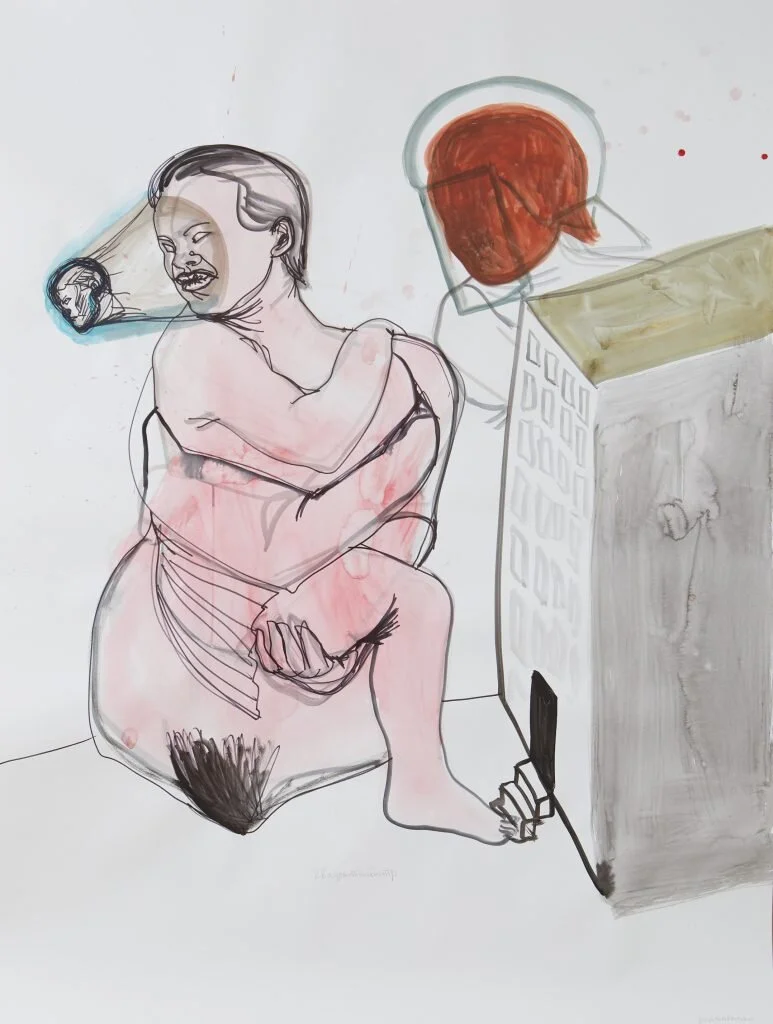
P. L.: “I covered my ears with hair” is the signature of one of the works, after which, according to the order given to me, paintings with pieces of the human body begin. That is, after a verbal call to control the corporeality, a physical invasion begins. Was this particular work planned as a logical intermediate link between works of one format and visual means to another (more distant, speaking works that show the direct manifestation of ideologies — and more closed, concentrated, with multiplying fragments of human “flesh”)? How important is the order of viewing paintings, the narrative of the narrative in the “Zone of Silence”? What sequence did you use in the process of creating the cycle?
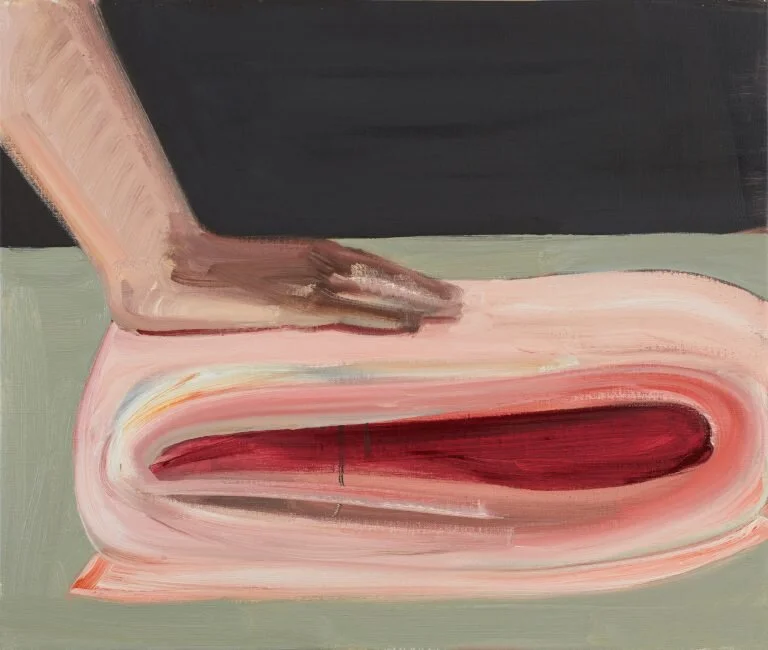
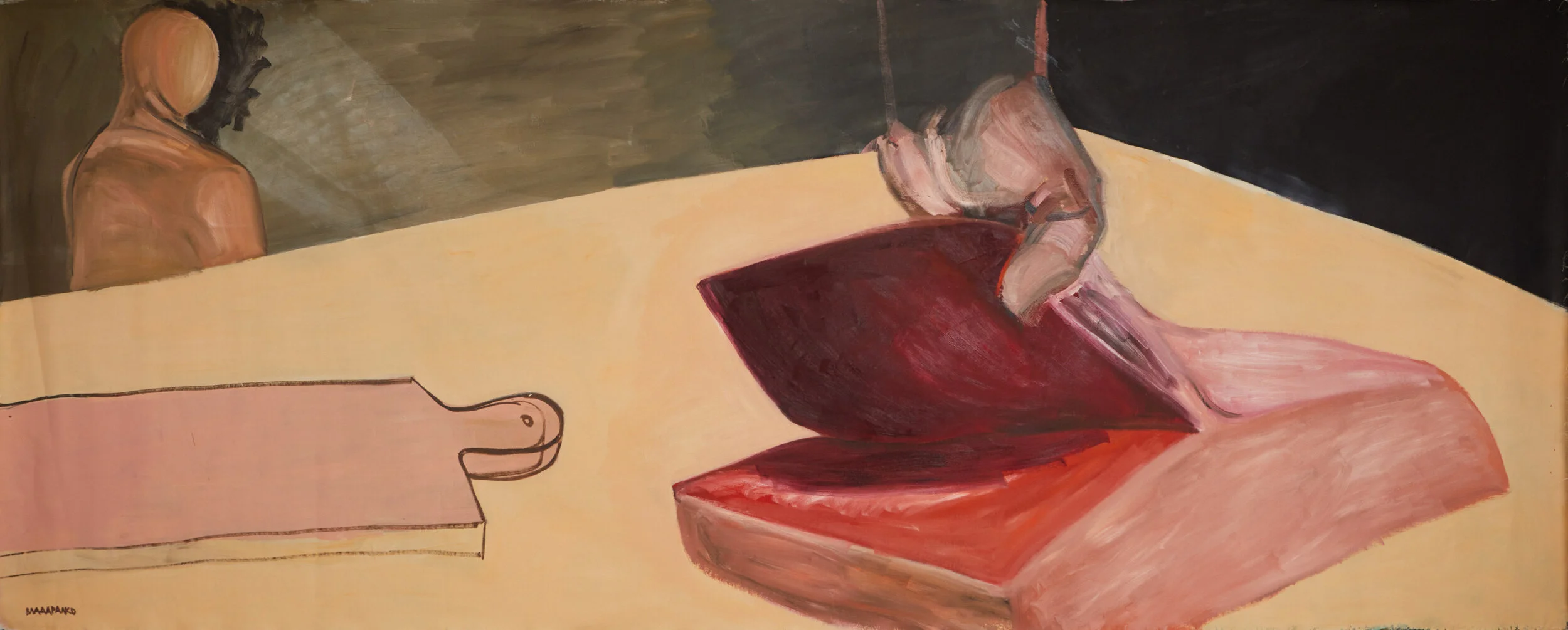
IN. RIVER: You insist on the belonging of body parts to man, which, in fact, I cannot deny. Of course, I mean the metaphor now! But I would like to keep in focus not the body, but rather their interaction. When during the work I was clarifying the details of individual compositions, I suddenly realized that the effective and subordinate ones are made of the same material. The hand that presses, caresses or cuts with a knife, and the forms over which it rules, seem to become accomplices. Thus, a certain secret kinship of oppression with consent to it was revealed.
Speaking of chronology, I made the drawings last, which seems to make the continuity you proposed impossible. However, it would be wrong to rely only on the time order. Usually, in my imagination, the work on all the works of the project is somehow particularly concentrated and it seems that the works arise in parallel. This feeling is due to the fact that much of what is done now in the residence I have kept in my head for a long time. It turns out that the process of work directly in the Kanev workshops seems to squeeze time, because it seems to me that the work lasted a very long time, and this period, which lasted a little more than a month, stretched for years. Because of this, it seems impossible for me to build a project according to a certain sequence, which will vary depending on the way the works are displayed: in the book it will be one, in different exhibition spaces it will also be different.
P. L.: And finally, a concise question: why is the name “Zone of Silence”? Is this a reference to the “zone of silence” in Kanev (Tarasova Gora) as a metaphor for the permanent limitations of man in a certain (cult) space?
IN. RIVER: Plates with the inscription “Zone of silence” are located everywhere on Monastic Mountain. For a long time, this precept with the compulsion to silence has not given me rest, but it is now that I realized its exact correspondence to the everyday silence of everything that does not correspond to official or traditional views on the rules of handling valuables, and in this particular case, with the national symbol, which is Shevchenko. Such regulated silence turns to violence when speech, namely the language of art, personified in the poetic word, is subject to dumbness. The complex, controversial figure of the poet is silenced by an indelicate prohibition contained in two short words.


.svg)