

In 2018, RedBlack issuedbook “Minenko”about the Canian artist. The publication considers many aspects of the work of Lyubov Minenko: features of her landscapes, portraits, collages and typical images. On the site we publish a biography of the artist, which is also included in the book.
The house in which Lyubov Minenko grew up is now more than a hundred years old. The house is located in Kanev, on one of its many cliffs. From the moment it was erected by the grandfather of Love, the house was transformed many times: first by the father of the artist, and then by her own hand, until it became a full-fledged workshop house. At the moment it is an interesting and slightly bizarre construction, a kind of synthesis of typical Ukrainian peasant huts and creative space.
However, many years passed before the transformation, during which the owner of the house was formed as an artist. Lyubov Minenko was born on May 5, 1950 in Kanev. Awareness of herself as an artist began quite early — when the girl studied in the second grade of secondary school. The distribution of duties in the family was in favor of Lyubov — his mother, Galina Sheremet (1922—1985), distributed tasks to four children in the same way: “You pull hay, you will eat in the garden, but do not touch Lyuba, she draws.” Support came not only from parents. Already in the fifth grade, the girl began to be encouraged to draw at school. This gave the artist the opportunity to delineate her artistic space and, at the same time, separated Lyubov from other peers, forced her to keep a distance from classmates — a circumstance that will accompany Minenko throughout her life.

Strong support from the Kanev community also had mixed consequences. Self-confidence, the presence of some school awards, encouraged Love to continuous development. So after the 10th grade, without any art education, Minenko goes to the capital to enter the Kyiv Art Institute (now — National Academy of Fine Arts and Architecture). It is obvious that academic education at none of the times was open to the experimental, not inscribed in the framework of the accepted. Enthusiasm was not enough: they required technical skills, thorough knowledge of the composition, the basics of drawing — that is, those things that Lyubov Minenko could not master in his hometown. Next, there will be another layer of students, which significantly limited the possibility of admission for individual applicants. These are children of already famous and honored artists, students of well-known Kiev masters, who all their lives were in the right context and had a wide range of acquaintances in the creative environment. Given all these obstacles, Love did not pass her first exam at the Art Institute - at that time it seemed like a tragedy for the girl. At the same time, it became an impetus for self-improvement, tireless work on one's own skills.
The solution for Minenko was found immediately after the results of the exams, but by chance: when the girl was sitting on Lviv Square near the institute and crying next to her folder of drawings, an architect approached her and offered to work privately with a familiar artist. On Velyka Zhytomyrska Street, in the center of Kyiv, there lived a woman named Evgenia, a friend of Tatiana Yablonska. She offered Lyubov a kind of exchange: the girl would live and study in Eugenia, and for this — do all the housework in the apartment. It is unlikely that such an existence contributed to true integration into the artistic community, so after three months Minenko simply ran away from that dwelling. And already in winter, she illegally began to visit the studio of Vasily Zabashta (1918—2016), a famous painter in the sixties. The illegal visit was because in the middle of the school year no additional sets were held, and officially Minenko was not part of the group. But there were no objections from the teachers: for Lyubov the practice of drawing was in the first place, so she taught much more diligently than her classmates — if for them it was already perceived as a passed stage, then for Minenko everything was new and inspiring. The artist quickly mastered space, volume and shape — in about three months. However, this did not help to immediately pass the exams to the institute: the drawing had already scored a passing grade, but painting was an unmastered field. There was still room for further work.
During her studies of the basics of artistic creativity, Lyubov worked as a naturalist at the institute — she received 80 kopecks per hour of work. During this, there was a case that was remembered by a woman for life. Once Minenko was going to class when she was stopped by Tatiana Yablonska (1917—2005). The cult artist asked the girl to pose naked for the students, and Lyubov did not accept the refusal - she insisted that the class needed just such a figure as hers. Minenko replied: “I will pose naked for you only if you undress yourself.”Yablonskaya's indignation at such a response resulted in the fact that the professor hit the girl with her handbag and for a while forbade the guards to let Minenko into the institute premises.
However, already at the entrance of Lyubov in 1971, the role of Tatiana Yablonska completely changed — the famous artist protected the applicant at the entrance, thereby helping her to finally enter full-fledged studies. The defense was needed because some time before joining Minenko there was a conflict (which Minenko himself describes as harassment) with another respected artist — Ivano-Valentyn Zadorozhny (1921—1988). So the exam was held in a tense confrontation and defense of Love's right to study in KHI.
In the end, the artist entered the pedagogical faculty, from where she almost immediately transferred to the theater department of the painting faculty. The newly created workshop needed a set of students, so there was an opportunity to join the group. Minenko took advantage of it, and since then the theater has entered the life of the artist.
The first years of study were conducted under the guidance of theater artist Nikolai Dukhnovsky (1908—1999). And a year before the release, in 1975, he was replaced by Danylo Leader (1917—2002), who brought a completely new vision to the artistic perception of Lyubov Minenko.
The artist drew inspiration from completely different sources, very rarely from theoretical academic books. The most expedient was to gain practical experience, and if we turn to past artistic currents, then directly, bypassing extraneous views of art critics. Thus, for Minenko, images of folk icons became key, which they explored during their studies with Ivan Gonchar (1911—1993), traveling through the villages. Subsequently, the artist will often focus on them as a naive, mostly unconscious attempt to recast already known and many times created biblical plots. The next significant experience for Lyubov was the acquaintance with the work of Anatoly Petritsky (1895—1964) — his theatrical images were especially influenced. And it was not about copying or imitating, but about the beginning of awareness of one's own artistic practices, an impulse to process different ideas from a personal perspective.
But in fact, the turning figure was Danilo Leader. Mainly because of the ideas that he gave students to reflect on. The work of the theater artist ceased to be perceived by Minenko as an additional decoration, a collection of illustrations to the script. It is not enough to reread the artistic statement, harmoniously fit into the theatrical idea. The attitude towards the actors in the production also changed — they were no longer the main characters of the Leader's theater, but an equal part of the entire artistic action, they were at the same stage with the artistic design of the performance. In fact, Danilo Leader brought the role of a theatrical artist to the forefront, made him equal to the director and actors in the possibility of their own interpretations of works.
In the same period, in 1975, Lyubov Minenko performs his first work on the design of a theatrical production — “Not simple, but golden” by Yukhim Chepovetsky. After that, he begins to work on his thesis, for which Taras Shevchenko's “Lily” was chosen. However, the diploma, although highly appreciated by the teachers of the institute, was never put on the stage. Presumably, the design did not correspond to the prevailing ideological line, the artist began to be accused of nationalism. In the same years, Minenko created sketches for the play “97” by Nikolai Kulish — a very ambiguous production at that time, and the figure of the writer from the “shot Renaissance”. After that, the artist began to feel, in her own words, under the constant supervision of the KGB. This circumstance, as well as the pressure on Lyubov's husband, soon forced them to leave Kiev.
The artist married in 1973 to the jeweler Nikolai Minenko. Since 1976, the couple began to be pressured by censorship and surveillance by the KGB. So Lyubov sought a work assignment to the theater in Khmelnitsky, taking her husband and two daughters with her. So from 1976 to 1978 the family lives outside Kiev, and Lyubov Minenko realizes himself as a theater artist.
After the education of Leader, work in the Khmelnytsky Theater could seem like a certain creative limitation. Many ideas were rejected, did not accept too eloquent scenery. So, during the production of “Natalka Poltavka” they insisted on “folk decoration”, and in fact only added images of sunflowers to the design. One of her successful projects Minenko considered the production of Ivan Kocherga's “Vichy Wedding”, at the same time he sincerely admires the work of Lesia Ukrainka and Mykola Gogol. However, the disputes did not stop, especially between her husband Nikolai and the theater team. As a result, after living two years in Khmelnitsky, the family returns back to Kiev. This is how the theatrical activity of Lyubov ends — after that the artist no longer participated in the design of the performances.
In Kyiv, Minenko makes another attempt to join the artistic life of the capital. The task was complicated by the fact that there was neither work nor connections to come to Kiev in Lyubov. But in 1981, the Union of Artists proposed to fulfill a state order. Minenko was to develop a nine-square-meter minting for the House of Marriage at Chervonoarmeyskaya (now — Velyka Vasylkivska). The head of the school was Valentin Zadorozhny — actually the teacher of the Kyiv Art Institute, with whom the conflict took place in Lyubov even at the stage of entering the alma mater. The artist made sketches seven times — both plastic and painted — and was rejected seven times. For the eighth time she was “lucky”: Zadorozhny was in the hospital, and the deputy approved all the sketches and suggested that Minenko choose the option of minting on his own. The completed work stayed at the Marriage House for exactly three days — after that, however, an order was issued to remove it.
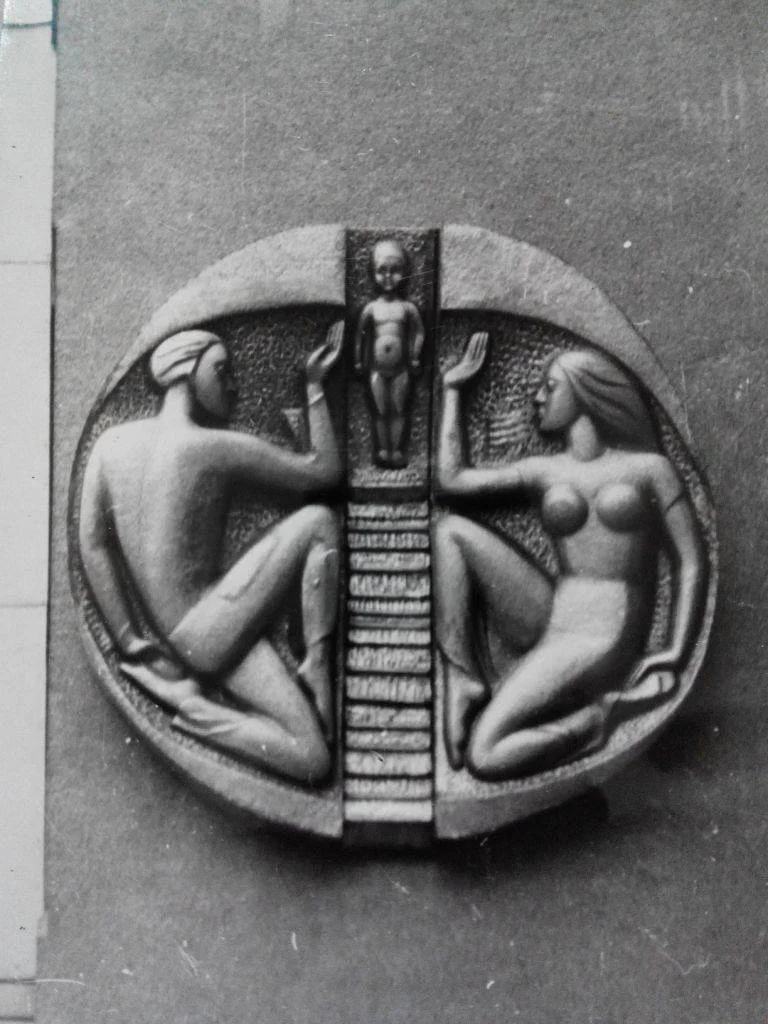
For Love, this was a strong blow at the time. For a long period, almost a decade, the artist retires from creative work. Sometimes she makes “for herself” applications or watercolors, but most of her life is occupied by family life and helping her husband in his projects. Nikolai Minenko was then actively engaged in the development of modern jewelry, which greatly fascinated his wife. Lyubov herself called herself a “producer”, because she directed her own energy to promote the work of her husband. The main venue in the 1980s was Andreevsky Uzviz, where the couple went out once a year — and jewelry was bought from them in half an hour. Impressed by the commercial success that Minenko had achieved over ten years, in the early 1990s they wanted to organize a full-fledged exhibition of jewelry works.
Lyubov Minenko went to the new building of Taras Shevchenko National Museum and proposed their concept of the exhibition. The idea was accepted approvingly, but it was noted that they can exhibit only with reference to the Shevchenko theme and, preferably, together with artistic works. Here it turned out to be “useful” that Lyubov herself is an artist. It was agreed that her works would hang on the walls, and in the center of the halls, on the tables, the products of her husband would be displayed. And although the light in the exposition often fell only on jewelry, all the same, the images of Love were eventually paid much more attention.
At that 1992 exhibition, Minenko did not show any new works: the audience and collectors were presented with old theatrical sketches and sketches for Shevchenko's “Lily”, Lesya Ukrainka's “Forest Song” and Mykola Kulish's “97”, as well as numerous applications of the artist. For Lyubov Minenko herself, it was a huge surprise that absolutely all her works were bought out after the exhibition, and the work aroused the interest of visitors. In fact, there was a disorientation in the usual way of life: the exhibition promoted not so much Mykola Minenko as Lyubov — and something had to be done about it.
There were several factors that stopped the artist from enjoying success. The main thing is the lack of understanding what to do next. The artistic circle has become even more distant from her than it was in her student years. A long break in creativity gave a feeling of lagging behind current trends, there was a lack of information, what is accepted now in art. But the process has already been launched: Minenko began to generate new images in extraordinary numbers. This was facilitated by a meeting with political prisoners with whom the artist had friendly relations — Yevhen Sverstyuk (1927—2014), Nadeia Svitlychna (1936—2006), Mykola Plakhotnyuk (1936—2015). Their ideas, sounded in conversations, strongly influenced the mood of Minenko's works. Creative activity reached a new peak: the artist had several exhibitions a year in various institutions, created an extraordinary number of works, which were just as quickly sold out.
At the same time, the fear for the nature of one's own work did not disappear — there was no sense of “self”, there was no ability to appreciate one's own art. Her institute teacher, Danilo Lider, helped the artist in this again.
Their meeting was quite random: they both lived in the Pechersk district and one day they clashed on the street. Lyubov asked the Leader to evaluate her work, because she did not doubt the sincerity of his opinion — and she received a rather high rating. On the joy of the meeting, Minenko dedicated the next exhibition at the Museum of History of Kyiv to the birthday of her teacher. At the opening there was another blow for the artist: the leader gave a speech in which he analyzed in detail (and positively) the work of Lyubov Minenko.
Why, in fact, was it shocking for the artist? Her approach to her own art has always been anti-reflective — without layers of theory, thinking about actions; intuitive, hard, and quick to work so that there is no time to stop and evaluate. On the one hand, as we have already seen, it became the basis and a kind of uncertainty about his own significance as an artist. On the other hand, without this approach, it is impossible to create paintings close to naive art. And when Daniel Leader began to speak at the opening, he made a real decryption, laid out on the shelves everything that previously existed exclusively in the form of condensation of energy. It is not surprising that it is similar Desacralization art in the first place shockingly influenced the author herself.
It took Lyubov Minenko several months to accept and let go of all this. In general, the awareness of how it works, allowed later not only to return to the process of creativity, but also to absorb new meanings into it. Fear of herself began to recede, Minenko began to position herself more strongly as an artist.
In the end, the artist will understand the need for her own space of activity. Kyiv begins to be less adapted to her creative ambitions: firstly, over the years of art in Minenko's images, not a single Kiev theme has appeared; secondly, life itself begins to interfere. In the house where the woman lived with her husband and children, there was no opportunity to create her own workshop, and Nikolai Minenko was somewhat jealous of his wife's activities. And in 2003, at five in the morning, Love literally runs away from home, not wanting to quarrel with her husband, and returns to Kanev forever.
This was facilitated, in particular, by a very shaky attitude towards her parents' house, where Minenko was born and raised. A few years before her move, Lyubov's father, Pavel Shulzhenko (1924—1997), died, and the woman began to worry about the building, which could collapse without constant care. And Lyubov Minenko goes, not least, to care for those walls that inextricably link her with her native identity.

In Kanev, nothing and no one prevents the artist from turning her residence into a workshop. At the same time, adaptation to the new conditions of life was not easy: household affairs took too much time, and the constant need to survive alone with herself made the artist, as she herself admits, much stronger morally. Nevertheless, all this became new impetus for creativity, provided many topics for reflection and, subsequently, for artistic images.
It is also interesting that it was in this boundless space of practice that Lyubov Minenko first became attracted to theory. Since 2004, the artist begins teaching at the Kanev College of Culture and Arts, at the same time she studies various currents of modern art - because, according to her own admission, she simply did not have time to attend lectures at the institute.
The exhibition activity of Minenko continues as before: almost every year the artist has personal exhibitions, both in Kaniv and in Kiev and other cities. However, sometimes Love is troubled: housework and teaching take too much time, and sometimes there are simply no free minutes left for creativity.
The removal of barriers often occurs due to new unusual circumstances, including in the life of Love. When Minenko was invited to the KrasneChorne art residence in the summer of 2017, the first feeling was stressful: the artist was afraid of the fact that other participants could create more than 20 canvases in one month. Minenko, after a very long break, decided to change her technique (which always affects semantic loads) — and took up watercolor works for the first time in seven years. As a result, Lyubov completed 60 works in a month — another striking example of how unreflective and intuitive her art becomes in its performance.
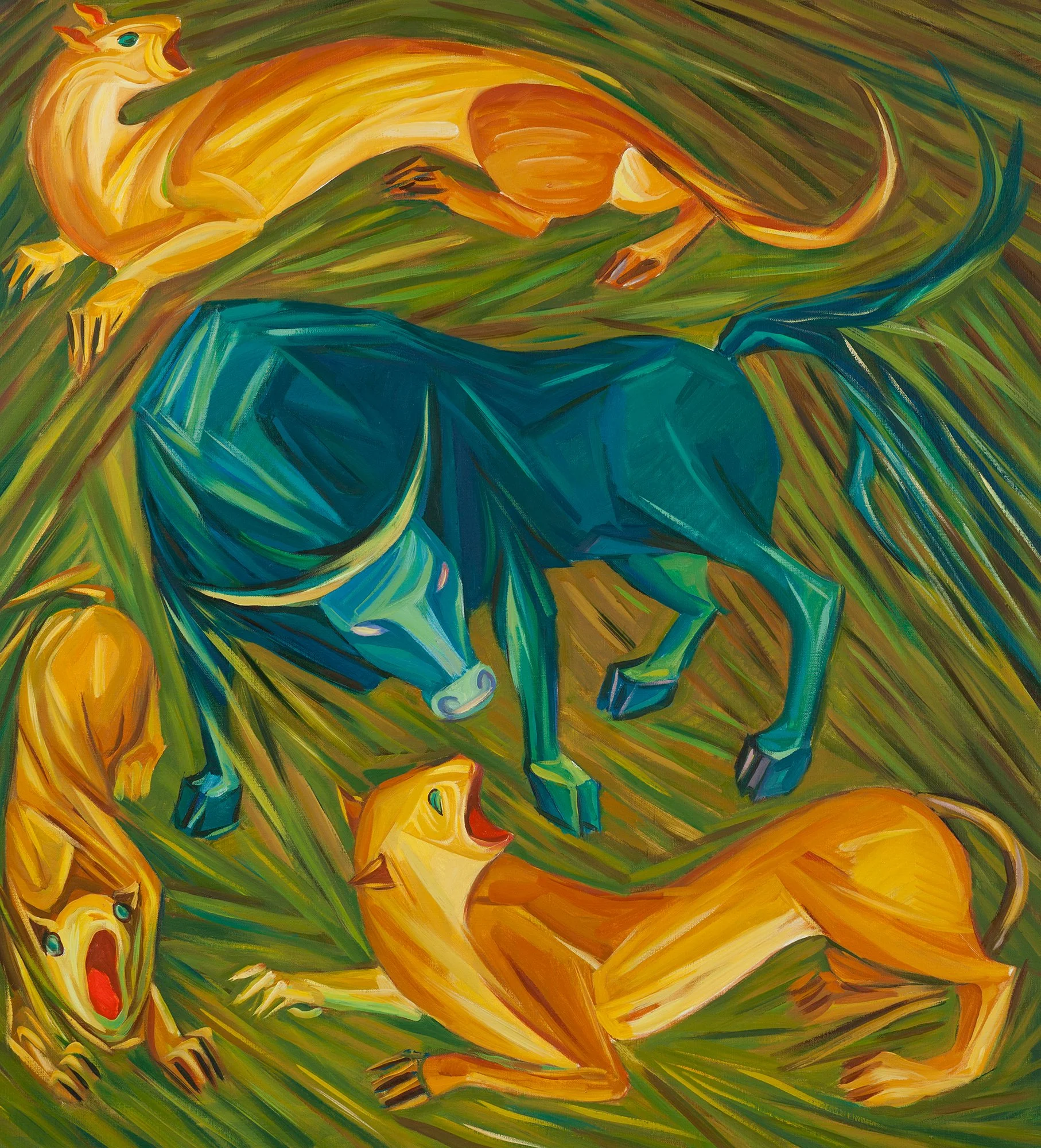
There is no border separating the personal life of Lyubov Minenko and her creative activity. Moreover, there is no watershed that delineates the concept”I”,”We” and”theyin her art: after all, the non-reflexive always refers to the unconscious, and that to the collective and archetypal. The artist transmits through her works not only herself, but also the conditional concept of the universal (which she often refers to as “patriotic” or “national”) that is present in her worldview. And thus, in the biography of Minenko, her work acquires a self-expressive, but not self-explanatory character. This is more an impromptu theater than a personal meditation.


.svg)