
For my birthday, the artist Vlada Ralko gave me an Aleppo soap bought in Berlin from Syrian refugees. We have loved him for a long time, regardless of each other. The gift set me back until the morning of February 24, 2024. Then, smoking incessantly and flipping through the news feed in my laptop, I thought of Aleppo. Those who destroyed the legendary city, known since the time of Akkad, could do the same with my Kiev. At some point, I felt that the gaze stopped perceiving information: sliding mechanically across the screen, it went deep inside itself.
The Aleppo soap discovered by the Crusaders, like the hygienic practices of Islam, slowly but profoundly changed Europe. For centuries after the fall of Rome, the secrets of soap making, like many other ancient achievements, were preserved in the Muslim world. “Ritual purity is half the faith,” the warriors of the great Kurd Salah ad-Din, faithful to the Hadith of the Prophet Muhammad, learned in advance of the approaching Christian knights from the stench they spread. Europeans' disregard for the purity of the body pushed Middle Eastern scholars to bizarre conclusions long before the Crusades. The 9th-century Persian physician Ibn Abu-l-Ashas, for example, argued that the inhabitants of northern countries molt like animals. And in the 21st century, the Italian physician Francesco Francisca published a study on the “demonized” longevity of medieval Templars. The reason was not black magic, but the imitation of Muslim habits - regular washing, refusal of pork.
What seems obvious quickly turns into a common sense stereotype. “I learn every time I see how the obvious closes my eyes to the real,” says Vlada Ralko. The obvious Eurocentrism prevents us from seeing the real of both Europe and the world in its history unfolding before our eyes. “Global conflicts such as World War II began because of the breakdown of balancing and containment systems: the events in Manchuria, the Spanish Civil War, the occupation of Czechoslovakia, the Anschluss of Austria.” notesDirector of the Scoucroft Strategic Initiative at the Atlantic Council Andrew Micht.
The beginning of World War II was announced to mankind by the Emperor of Ethiopia, Haile Selassie I — and he was not heard. “Do the peoples of the world not understand that, fighting to the bitter end, I am not only fulfilling my sacred duty to my people, but also standing guard over the last citadel of collective security? Are they so blind that they do not see my responsibility to all mankind? If they do not come, then I will say prophetically and without bitterness: The West will perish,” he declared in 1936 on the pages The New York Times.
The year before, Mussolini's forces had invaded and occupied Ethiopia, actively using chemical weapons. The League of Nations sanctions against the aggressor never took effect — largely due to the intrigues of the USSR. Chemical attacks with the support of Moscow were used against his fellow Syrian citizens by Bashar al-Assad. Chemical weapons against Ukraine are being used by the Russians. Their North Korean allies are already at war in Europe. What other escalation does she fear, meeting millions of refugees from Syria and Ukraine? And what does he see in terms of “stability”, “well-being”, “future”?
European prosperity is not a fact, but a process that requires effort, sensitivity and honest, not mechanical reactions.
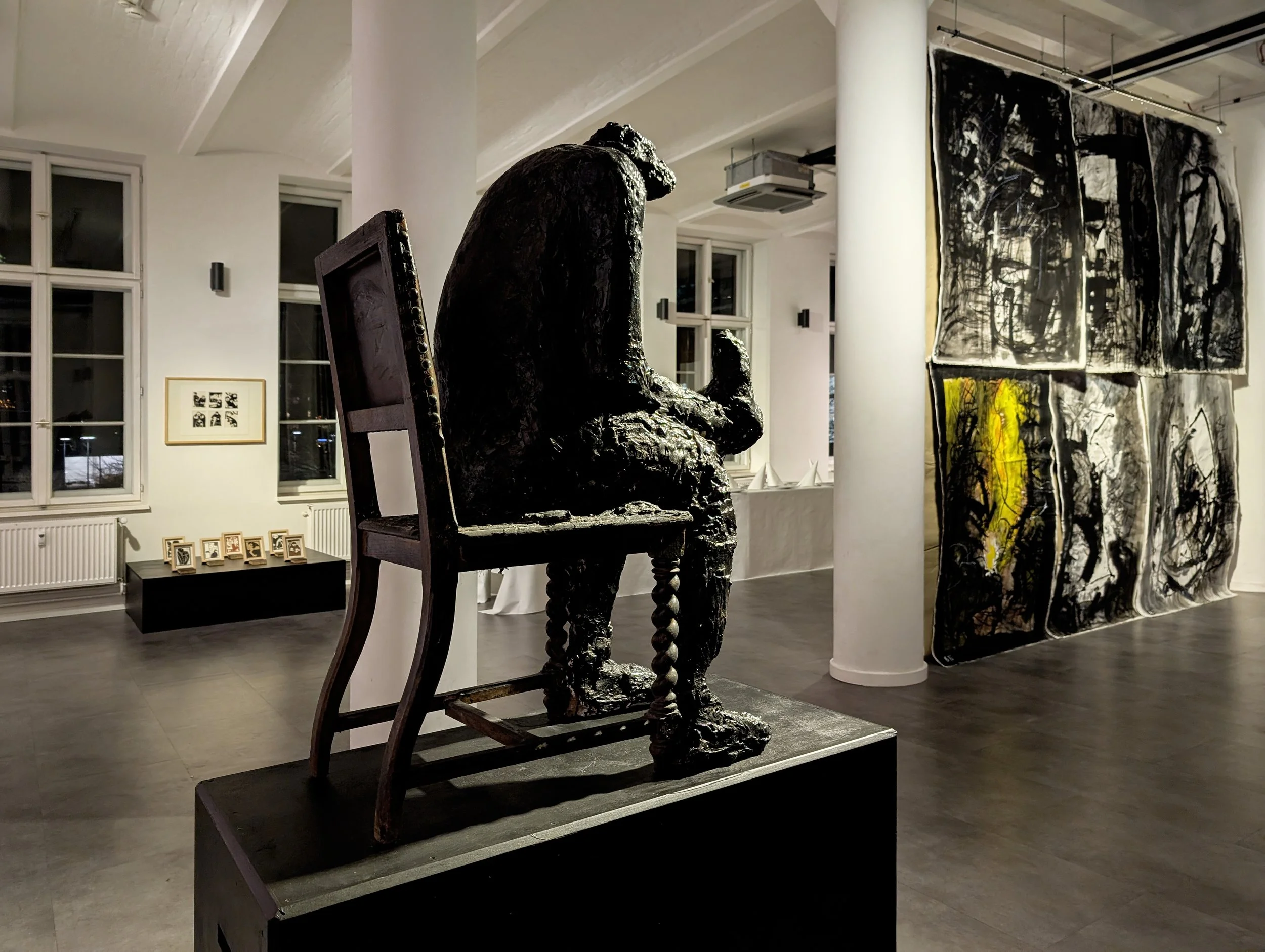
Curatorial project of Vlada Ralko “Face of the Eye”in the center of Berlin Hotel Continental — Art Space in Exileopens eyes to the fragility of these structures. The space, permeated with windows and columns, allows the gaze to wander between works, depriving the exposition of a rigid narrative and the viewer of the temptations of the obvious. The juxtaposition of works by contemporary Ukrainian artists and German artists of the Cold War dispels the illusion: European prosperity is not a fact, but a process that requires effort, sensitivity and honest, not mechanical reactions. Both the artist and the spectator for Vlada Ralko are a witness, and therefore a participant.
Bernhard Voghte's postcard-sized linocuts have been a message to us since 1985, when they were created for the May Day open-air festival in West Berlin. They are dedicated to refugees from Turkey and Iran, whose fate and rights were then hotly debated in German society.
In 1983, 23-year-old Djemal Altun, who fled Turkey after a military coup, was thrown out of the window of Berlin's High Administrative Court over a deportation decision. The tragedy caused street protests, intensified civic initiatives in support of migrants, and was reflected in literature and music. Voget dedicated one of his works to Altun.
Memorials to Djemal have been created in Berlin, Hamburg and Kassel, but the number of people who committed suicide in Germany due to the threat of deportation is now in the hundreds.
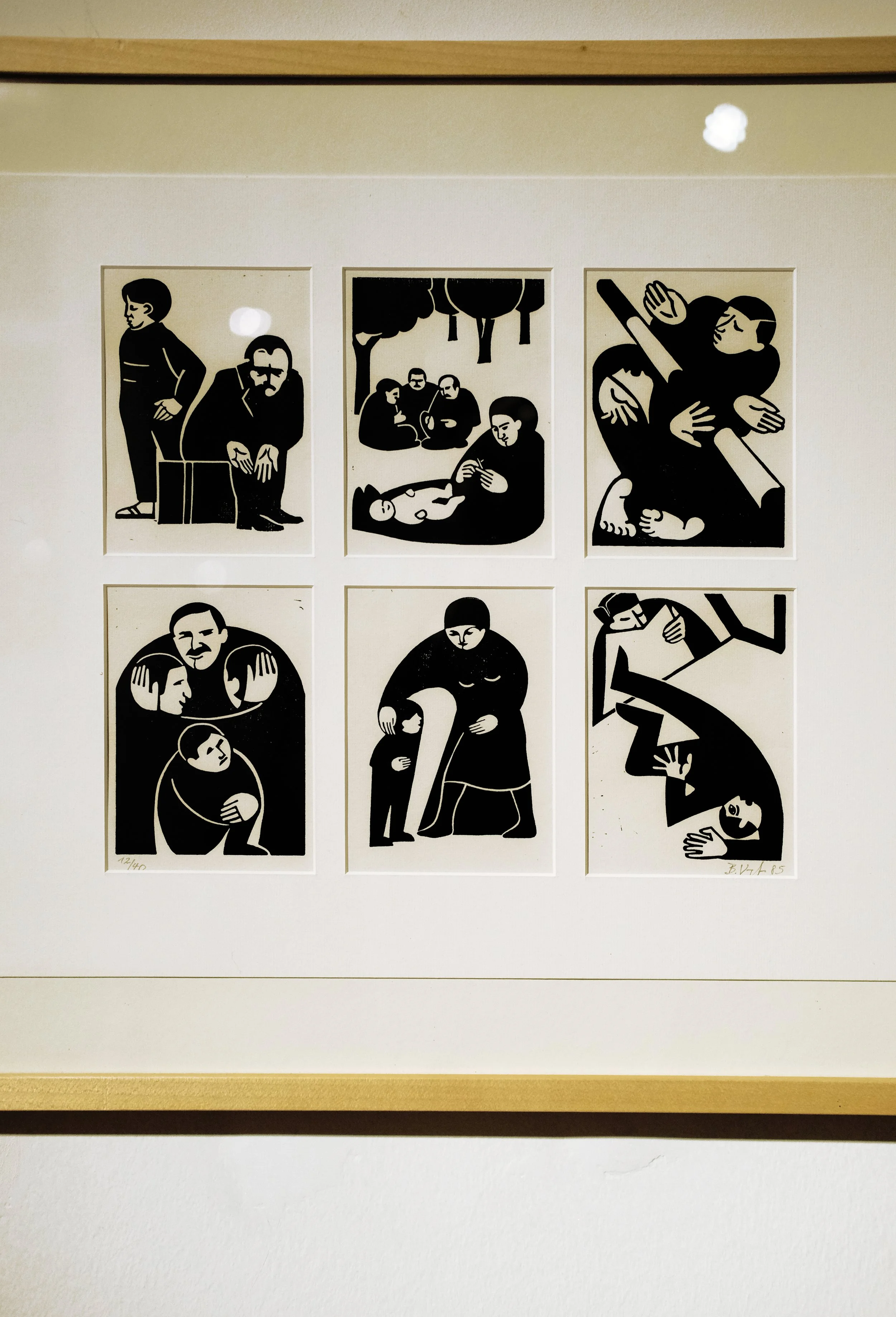
Vogt is a follower of Bauhaus. Vlada Ralko comments: “These visual forms are very close to us. If I had seen Bernhard's works in 1985, they would have touched me with nothing but skill. Today I understand that in the USSR, modernist techniques were used to exalt communist ideology and denounce capitalism, while Voghte embodied them in harsh criticism of his state. Soviet modernism is an oxymoron, the USSR destroyed modernism, reducing its use to propaganda.” In 2024, the functionaries of “Alternatives for Germany” demandedcritical review of Bauhaus's legacy as “the false path of modernity.” “Europe's comfortable niche is deflating. If during the Cold War there were oppositional political contexts, now everyone has a common context,” says Ralko.
Vladimir Budnikov was born in Kiev in 1947. A year earlier, George Orwell stated in The Observer: “Russia has started the Cold War...” On the eve of the collapse of the USSR, Budnikov discovers Western Europe, his work is acquired by Peter Ludwig for his museum in Aachen. Today they can be seen there on Exhibitions“Fragments of the once existing reality”, dedicated to the art of Ukraine. The Cold War is long in the past. But its main threat — the possibility of a nuclear strike — has been viciously revived by Moscow.
Hotel Continental presents works by Budnikov from the cycle “Personal Account/Mein Konto”. The indignant painting conflicts with the title, which refers to prosperous rationality. The digital cabinet is a place for establishing financial and information flows, the real one is the luxury of secluded thinking and planning. The war that broke out in the life of the artist brings the issue of personal account into the ethical and political plane. Budnikov's works scream about the default of the world trust loan, which began with the violation of the Budapest Memorandum by the Russian annexation of Crimea.
In 2015 in the project “Shelter” Foundations “ChervoneChorne”in Kanev, Vladimir Budnikov created a gallery of images of the nuclear fungus in abstract landscapes, reminding that life on Earth can remain beautiful even after the self-destruction of humanity. “Human beings, in fact, are not needed in this world. Just to watch. “We are the eyes of the world,” Yuriy Leiderman, another participant in the exhibitions “The Face of the Eye” and “Fragments of a Once Existing Reality”, writes in his Moabite Chronicles. He showed personal honesty of view, abandoning a significant position in the Russian cultural establishment, choosing the marginality of unconventional, extra-floor painting. Of the artistic phenomenon, one of whose leaders was himself, Leiderman says: “Moscow conceptualism transformed American performance — with its real prairies and volcanoes — into a “pseudo-performance” and thereby enabled the kitchen, private existence of contemporary art into a scoop.

No flag in the world is now raised as high as ours, yellow and blue.
In the midst of the events of the Kyiv Maidan 2014, the winner of the Andrei Bilyi Prize Yuriy Leiderman stated: “I cherish the dream of someday returning to my Odessa. And I would like to live in unitary Ukraine. With the only state language — Ukrainian. I am absolutely not intimidated by the prospect of being a “language minority”. (...) I don't want to offend anyone. But I think no flag in the world is now raised as high as ours, yellow and blue. And nowhere in the world do people now sing the national anthem with such courage and hope as we sing it. In Ukrainian.”
Leiderman's painting is fundamentally inelegant, it requires contemplation, which is fraught with random and not always convenient discoveries. Works from his “History of the Horse” are puzzled by human views of animals. The human figure is transformed into an animal in the sculpture “Part of the Study” by Dieter Rukhaberle. She is the antipode of the Rodenov “Thinker”. Replacing responsibility with curiosity, a person loses integrity, and with it humanity.
Dieter Rukhaberle's responsibility opened his eyes to German authorities and society. He initiated and headed social support funds for artists and free media in Germany, made unpopular political statements. For example, in defense of Bulgarian citizen Sergei Antonov, accused of being an accomplice of Ali Agja's assassination on Pope John Paul II. “The very idea that the assassination of the pope could have served the interests of the Bulgarian people or their government is absurd,” Rukhaberle told the Bulgarian Telegraph Agency. After four years in prison, Antonov was released by an Italian court “for lack of evidence”.
The smoothed head of the Rukhaberle sculpture echoes images of Vlada Ralko's graphic “Lviv Diary”, launched by her after the escalation of Russia's war against Ukraine in 2024. For both artists, political and civic are integral components of the phenomenon of “man”.
The chimeras of the “Lviv Diary” are images of Russians who have renounced the right to their own opinion, from subjectivity in favor of state power. But in “The Face of the Eye” Vlada presented another of her work - the installation “Sunday Lunch”.
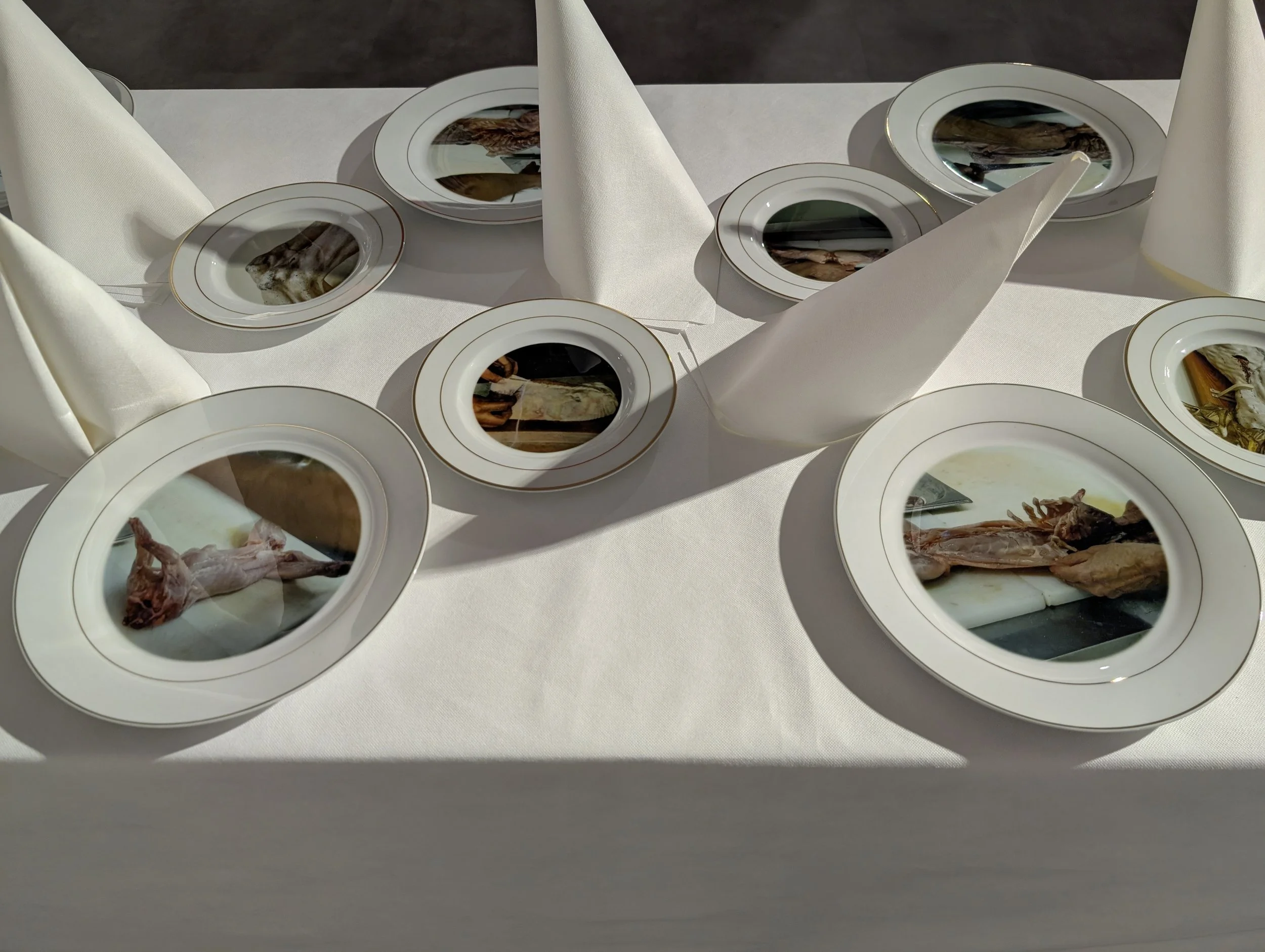
The porosity of the served table in the exposition causes a feeling of embarrassment. Similar to what we experienced as children, forced to participate in crowded Soviet family feasts, doomed to ritual friendliness. Prints on plates — photos taken by Ralko in the meat department of the Kiev Rye Market, on the Montenegrin beach, in the Pinzel Museum of Sacred Baroque Sculpture in the former Clarisok Church in Lviv, during the separation by the chef of the rabbit in the kitchen of the famous restaurant “Knyazha Gora” in Cannes Evi. The fragments of bodies — human and animal, carved from the tree of the crucified Christ — are an associative spectacle “about man's exit beyond the family circle, where he finds himself alone with his own body, death, god and beast within.”
“Face of the Eye” is the first foreign, but not the first international project of the KrasneChorne Foundation. Since 2011 he has been holding a sculptural symposium in Kaniv with the participation of authors from France, Georgia, Italy, Germany, China, Japan. Fourteen years ago, the founder of “Red Black” Yuriy Stashkiv saw Ukraine as a place capable of forming a new perspective in the dialogue of cultures. In January 2024, the sculpture “Meditation Space for a Monk”, created by Japanese Yoshio Yagi as part of the 2019 Kanev Symposium, was installed in Irpen near the destroyed Central House of Culture by the Russians.
Kaniv is a place of strength for Ukraine, where Taras Shevchenko wanted to live, admiring the rebellious Dnieper. His dream did not come true, but he is buried on the cliffs of Kaniv. In Irpen, the world saw a new place of strength. Without waiting for the restoration of electricity and water supplies, the help of government agencies and international donors, the Irpinos rushed back to the city liberated from the invaders. Joining with neighbors, jointly buying building materials, cooking open-air food on wood, they rebuilt destroyed homes on their own.
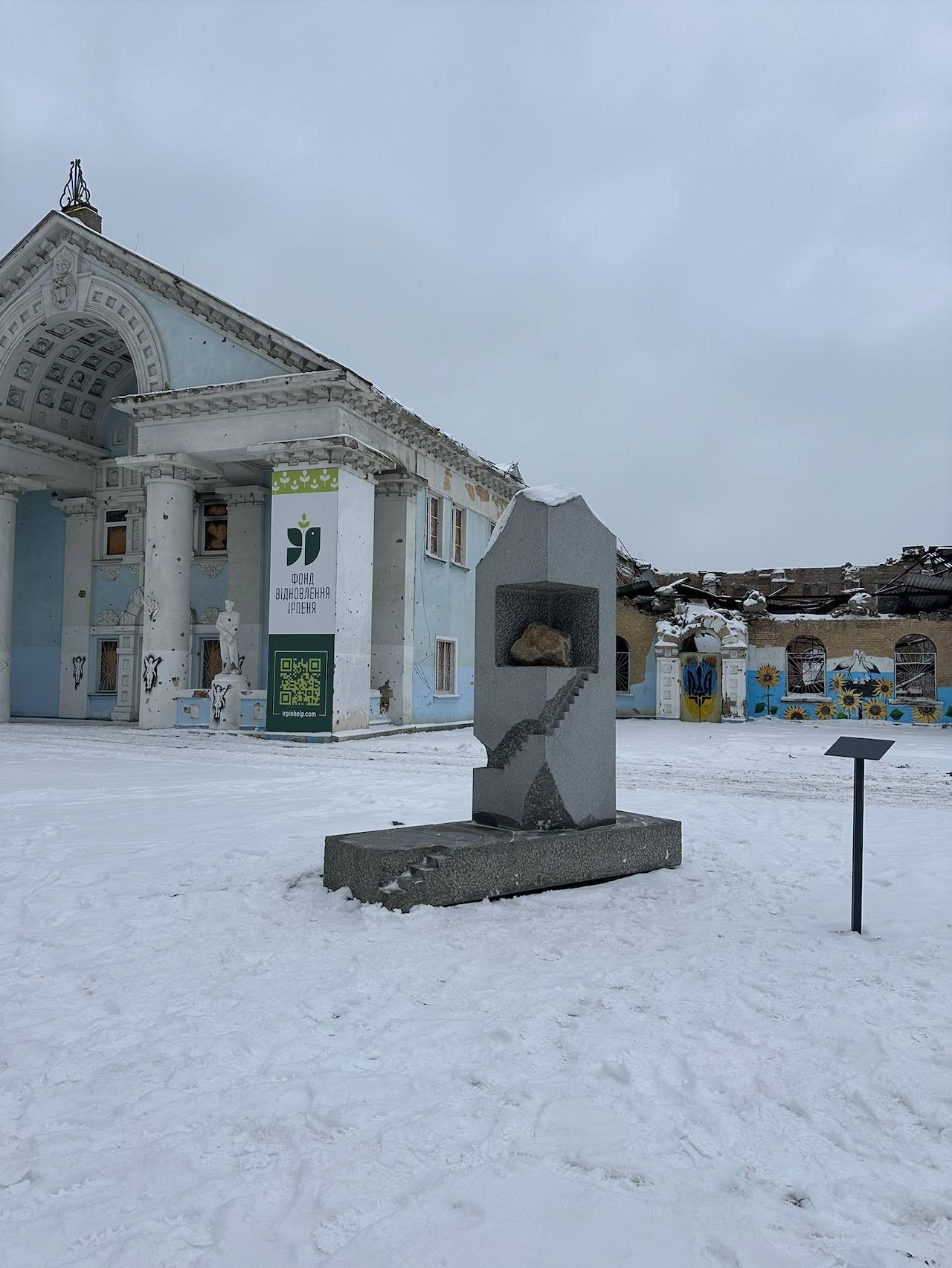
The stairs symbolize the ascent to the top, where meditation and purification take place. On the pedestal — like the traces of the Dnieper on the sand. As if rising from the surface of the water, the sculpture rises into the sky.
In Kanev, Yagi commented thus on “The Meditation Space for the Monk”:
“The stairs symbolize the ascent to the top, where meditation and purification take place. On the pedestal — like the traces of the Dnieper on the sand. As if rising from the surface of the water, the sculpture rises into the sky.”
To the Irpinans, who, despite the trials, see and create their future, such an image is especially close. And monastic solitude is a reminder of the feeling of loss and loneliness after the world in your world disappears.
“Destruction is a signal that we must create something new. Symbolically, the metaphor of the revival in Irpin will include the stone of the work of the Japanese master. When a Japanese creates a garden, the first stone enters there. After the stones are laid down and they are well, they bring in the soil, plant the plants, build a house. In my work, I was convinced: artists and sculptors sometimes look ahead ten years. We must trust the author,” says Yuriy Stashkiv.
In the work of Yoshio Yagi, the metaphor of the staircase is present often and in various variations. On internet pagehis studio in Nagano is the work “Private Houses in Aleppo”, where the stairs are helplessly exposed among the ruins.
“After learning about the conflict-torn Middle East, Syria, where the ancient capital Aleppo was bombed, I thought of a peaceful Japan,” the sculptor muses.
How long will the peace last there? We can say: “Let's see,” but you can take responsibility.
In 2024, Japan ranked first among the countries financially supporting Ukraine and the International Criminal Court, remaining the third largest donor to the UN.
The text is translated into Ukrainian from the original. Original source:
https://www.svoboda.org/a/my-glaza-mira-otvetstvennostj-zreniya-i-dialog-kuljtur/33277655.html
Interview of Vlada Ralko on the TV channel “Dim”
https://youtu.be/H4NPRNuoqps?si=EP3XXEES_81Fe27n
Reviews and reviews:
LB
https://lb.ua/blog/yuliya_manukyan/656170_oblichchya_oka_vdivlyatisya_temryavu.html
Kyiv Daily
https://kyivdaily.com.ua/dialog-pro-nasylstvo-pamyat-ta-vidnovlennya/


.svg)