

Within the framework of the X Kanev International Sculpture Symposium, a competition for art critics was held for the first time. Its goal is to promote the emergence and development of art critics and art critics interested in sculpture and spatial art in the public space. According to the results of the jury evaluation, the second place in the Competition was taken Natalia Mandra. We publish the winner's text.
Crucially important to public sculpture is the dimension of the public sphere — so important that it often prevails over artistic qualities. In this area, sculpture appears as a kind of encoding of social interactions — just like street graffiti, murals, monumental panels, advertising, and other visual phenomena.
Each of these varieties of coding is better suited to individual social aspects. So graffiti will reflect the mood of society (this is the shortest channel of communication, respectively, here the “spirit of the street” will be most clearly visible); advertising will reflect mainly the standards of social communication (it will operate with stereotypes, wrapping them in new visual trends); murals, monumental panoramas and sculpture as sanctioned objects requiring significant financial investment will be most related to politics (in its understanding as a set of practices regarding the social structure). Thus, the public sculpture will display markers of the social contract. In some cases, it will be a kind of container for the cases of new social contracts (as this has been perfectly demonstrated The project of the same namepublic art from the Izolyatsia platform in 2016—2017).
If you define public sculpture as markers of politics, then cultural diplomacy in the aspect of sculpture will appear as the erection of markers. In other words, how to synchronize worldview spaces by comparing cultural patterns. The difference in social structures, manifested in the comparison of such markers, causes a number of typical reactions, in particular, its perception through the prism of exoticism. This creates a problem, because next to exoticization is also typical of othering, and with it, for its part, the appearance of colonial optics (which is clearly seen even in the example of domestic policy, in particular regarding the east of the country). First of all, however, I want to emphasize not on political strategies such as colonialism, but on the worldview attitudes that underlie representation policies.
A good example here would be the Cartesian division as a worldview basis for the distribution of power. The Cartesian division is associated with the appropriation of object-subject status: thus spirit is considered subjective (active), nature is considered objective (passive). By analogy with it, the socio-political status distribution has taken the form in which a man is considered a subject, a woman is an object, a metropolis is a subject, a colony is an object. The philosophical justification of the possession of the active principle (spirit) over passive matter became the basis for concluding the “naturalness” of man's domination of nature, man over woman, of some peoples over others.
This is based on the current imbalance in culture, in particular the imbalance of power. The reproduction of this traditional hierarchy of power is realized mainly in monuments to politicians and heroes, and usually translates into the installation of sculptures on the principle “tradition and order are ready to take control of everything and promote a politically determined historical narrative”.
However, a traveling sculpture appears and thus communicates that it does not want any control over itself, much less a traditional one. There is a hidden sculpture that still needs to be found, because it can be overlooked immediately (because it — or rather its authors — does not seek to dominate the space and the audience). She, in addition to being proportionate to a person (this is a reflection of the requirements of a democratic social structure), has the trait of unobtrusiveness. It seems to dissolve in the environment, like the Homomonument (a memorial in the historic center of Amsterdam), which has a shape (triangle) and color (pink granite), but voluminous very selectively, only in individual parts of the monument: on one corner of the triangle there are stairs, on the other - a little climbing is a mini-triangle. The last angle is planar. Because of this, integration with the environment is maximum (as the author of the monument - Karin Daan set herself the task). Also, an example of a sculpture very integrated into the environment is Nazar Bilyk's “All the Gold of the City”: a granite boulder with only a few small fragments of the surface bearing traces of the sculptor's intervention — gold spots. The works “Space Around” and “Rain” by the same author are examples of humanistic sculpture in urban space, which in function and worldview approaches humanistic literature, because it convincingly demonstrates the shift of focus from representations of the relationship “power-man” to the relationship “man-man”.
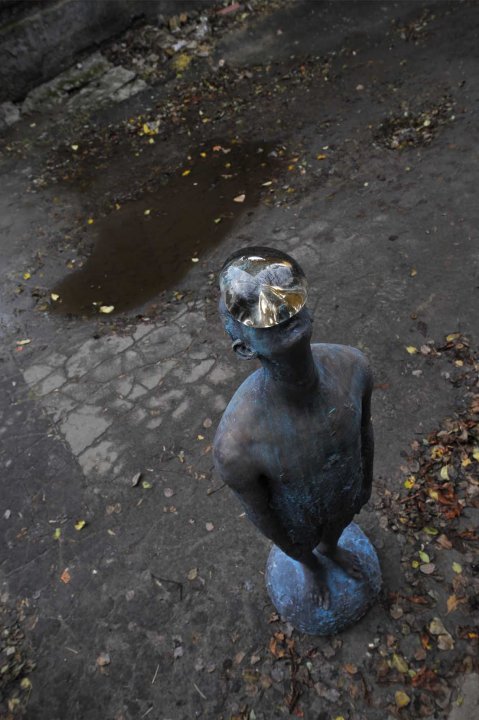
I see in this a marker of a movement towards balance in culture: towards a situation in which the public space will be filled not only with the ideologies of certain social institutions (political or religious), but also with statements in which the individual addresses the individual in a personal dimension. This involves the ability to see each other (rather than ideological projections in place of the other), and to build ties that are different from those of power, because ties are culture. Ukrainian artist Tiberii Silvashi in their reflectionsalso combines actions aimed at drawing connections with the general understanding of art in the new age: “The halls of the classical museum with “masterpieces” on the walls are replaced by a space in which “connections” function — this is a significant difference in the understanding of art, its function in the past and its role today. Culture is just the “connections” and their articulation.
The recipient in an invisible network of semantic relationships and semantic accents reads them in an undissected complex, as a holistic experience. In the public space, such semantic accents are sculpture. It represents a configuration of cultural connections, a network of conventional knowledge dissolved in space, which is perceived through the category of experience.
Thus, with the perception of sculptural works, markers of a new paradigm fall into the experience, which reflect the movement towards the reordering of social relations. Such works usually look like individual reflections of the artist embodied in spatial form. Modern sculptors see as their task the transmission of a personal message, the personal opinion of the artist (this is described in their interviews by Alexei Zolotarev, Nazar Bilyk, Vitaliy Protosenya and others), or the realization of the needs of the local community — after clarifying its needs (therefore, allowing local for the community to act as a subject) [2] rather than a directive from above (assigning to the community what, in the opinion of the subject of power, the ward object needs).
I think that the presence in our public sphere of markers of movement away from the social system anchored by Cartesian society is a good sign. We see where society is moving and we can track the dynamics of social change by what sculpture appears and disappears in public spaces. In those societies where sculpture becomes increasingly integrated into the environment, either temporary (as conceived by the artist) or addressed from person to person (rather than from top to bottom — from a representative of authority to subordinate), that is, where the prevailing decisions to install the sculpture decrease, the next step may be to reduce panic behavior, for example, of man in relation to nature.
For the most part, on the example of public sculpture in the city, we talk about interaction and communication between people, but very occasionally — about the interaction between man and nature. Moreover, “the city creates the illusion that the earth does not exist” — yes formulatedstate of affairs back in 1968 by artist and essayist Robert Smithson. — “Michael Heizer calls his earthen projects “an alternative to the absolute city system.” Although the essay with this thesis from the pioneer of land art was written half a century ago, in general terms the situation has not changed. How observesAnna Guidora, co-founder and organizer of the Landart Symposium “Space of the Border”, “Artists often come to Moghritz with sketches, but there is nothing left of these sketches, because here you find yourself in the atmosphere of a completely different space, and you can no longer apply what you come up with in the city “. Oleksandr Dyachenko, sculptor and co-curator of the Kaniv Sculpture Symposium, holds a similar position: “I was opposed to people showing sketches before the symposium. The sculptor has a CV, you can roughly understand his plastic language and his manner, and then — complete freedom for the author. For example, I often came to symposia without a ready-made solution. I often decide on the spot what I'm going to do, and so here [in the sculpture park in Kanev — for example, auto.] present improvisations” [3]. Such an improvisation, when it was interesting for Oleksandr Dyachenko to go simply from the material of natural boulders, starting from its outlines and texture, in particular, is the sculpture “Wind”. It is a very associative form that freely conveys the movement of the natural element and at the same time its constancy. She does this with one key means — texture, just by using different angles. If frontally the sculpture looks like a generalized human figure whose hair is blown by the wind, then from another angle more similarity will be guessed with the plant form. The smooth and serrated sides of the elongated alleged figure, in which the figure is no longer recognizable, but instead sees rather a tree trunk with emphatically distinct southern and northern sides, reproduce an effect that can only be seen on perennial trees. Thus, the artistic medium, which conveys the movement of the wind, at the same time conveys the impression of static, the gravity of time (visible in the layers of texture), its accumulation in a shape, as if in the tank of an hourglass.
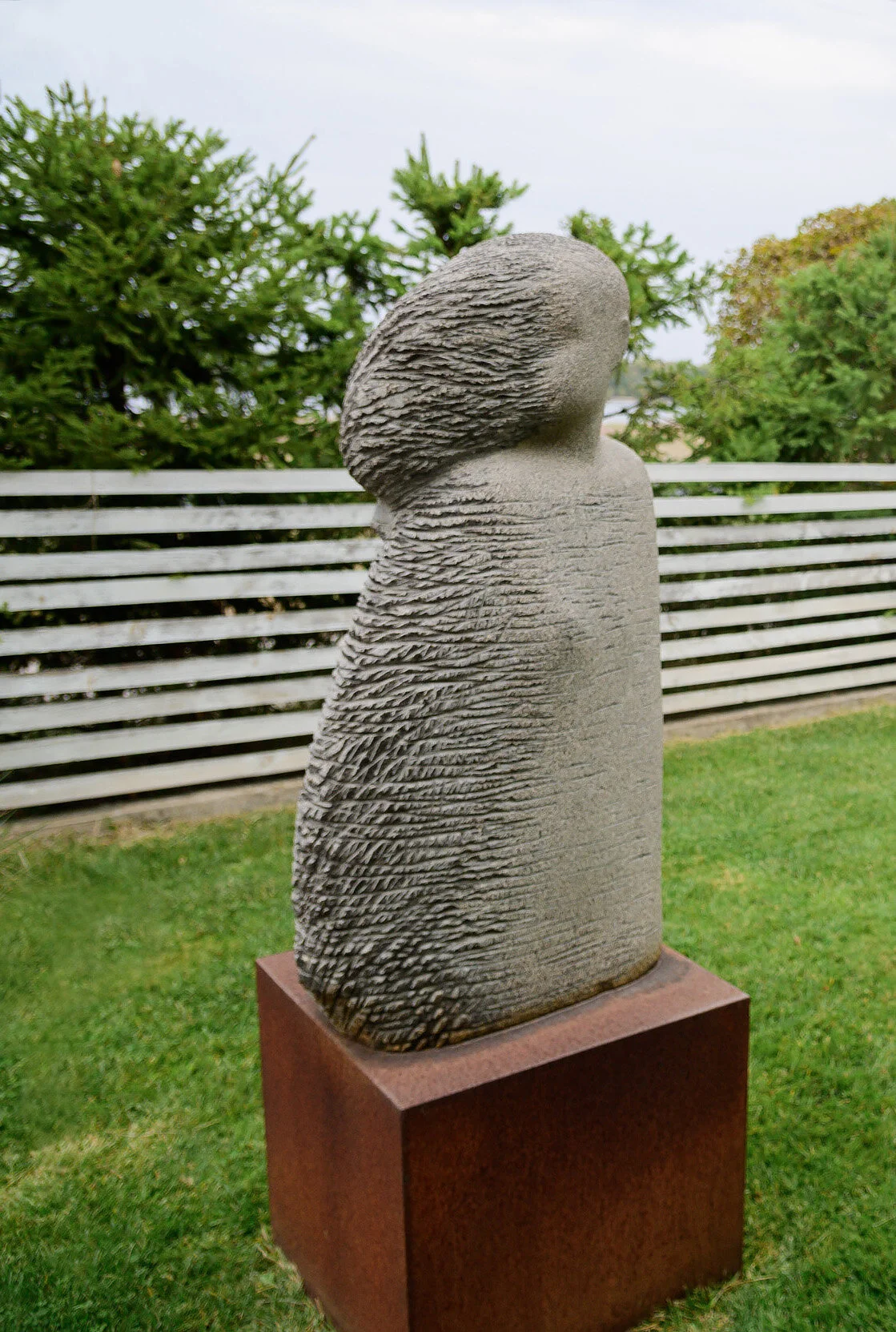
This kinship of the human, the plant and the spontaneous in the transformations of the stone form initiates a very synthetic perception. On the one hand, such synthetics on the verge of mythological is part of the archaic worldview, the plastic samples of which are very interesting to Dyachenko: “Cimmerians, Sarmatians, Scythians, Polovets... most of them my works are related to Polovets plastic” [4]. On the other hand, it also fits organically into the latest concepts of “flat ontologies” (alternatives to the hierarchical model of the world).
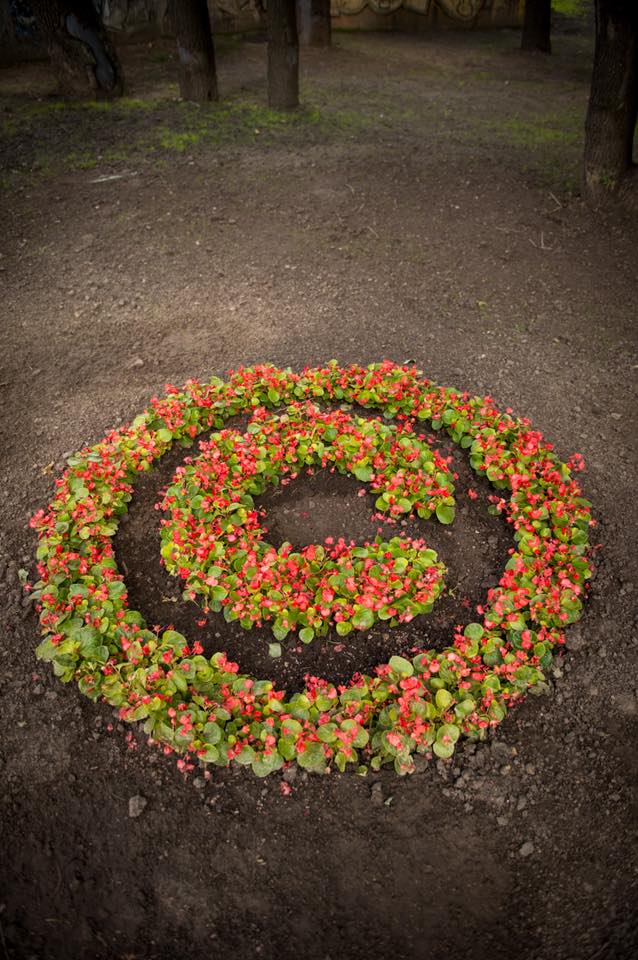
The approaches of the sculptural symposium and landart symposium curators are consonant, since in contemporary art landart and sculpture form an intermedial field (the field of interaction of different creative mediums). Public sculpture sometimes coincides in artistic view with landart — as a practice aimed at interacting with the environment. Landart's works in some places come very close to sculpture, like “To. Now. After” [5] Natalia Lisova, or included in the sculpture park's exposition, [6] as “Invisible Signs” by Latvian artist Gundega Evelone, consisting of reproductions in the landscape of two signs: tm, (c). One of them is made of plants — it is a flower bed in the form of a copyright sign: (c), “copyright”. In the volume park “Volume Park” it was also presented as a volume work, and became a proposal to consider the flower bed in those categories in which we consider sculpture: volume, shape, etc. At the conceptual level, the inclusion of this work in the sculpture park is aimed at colliding with the standards of thinking of the viewer.
Attempts of a new self-identification in relation to one's own thinking are also the plot of this year's Kaniv Sculpture Symposium participant Vitaly Protoseni. For him, this experience is related to the environmental space [7] and the Landart Symposium, where he participated, he said, “to move away from the very practical thinking of the sculptor, to move towards freer forms of expression, and to learn to think with the possibilities that nature gives”. Protosenia defined as the problem of “moving away from rigid divisions”, which he did not solve in two trips to Mogrica: “I still cannot, in this way of expression, erode the sculptural approach — clear calculation, framework” [8]. Nature has no framework, and this is at first somewhat disorienting in terms of artistic expression.
In general, many young sculptors are actively interested in interdisciplinary practices. Creative mediums have long intersected, intertwined and fused, and this is a problem for art theory, since theory in general still stands firmly on the ground of Cartesian division, mechanistic views, and rigid Aristotelian categories. But what is bad for theory (blurring the boundaries of the arts, interdisciplinarity, intermediality, etc. — a thousand names, precisely because it is an unsolved problem for theory) is good for practice. And if from the point of view of the artistic method such varieties of interaction with the environment as public sculpture and landart can form an intermedial field, then from the point of view of the result directly accessible to perception, they can form an environmental space. It is a utilitarian (particularly from the point of view of political ideology) space that, according to the creative idea, contains a certain conceptual, emotional or figurative-plastic expression [9]. The existence of ideologically neutilitarian spaces is important because, as Kateryna Mishchenko and Suzan Strettling put it, the concept of space is already so discredited by political history that it was only rediscovered after the 1980s as a subject of public and scientific debate. But if political history has discredited space, the environmental aesthetic rehabilitates it.
The humanistic intensities of sculpture and the harmonizing practices of the environment, combined in an environmental space, create a spectacular basis for worldview transformations. This is a two-sided effect — just as pro-government sculpture supports the existing social structure, so alternative sculpture undermines it. Therefore, sculpture parks as the most concentrated places of such influence make sense to do with the aim of demonstrating what kind of social structure we seek to achieve.
[1] Regarding the last point, it is present in recent publications of Ukrainian criticism, in particular, as follows: Asya Bazdyreva refersto a body of knowledge in postcolonial studies that “analyzes how the geographical division into progressive center and neighborhood legitimizes the Cartesian division into mind (agency) and body (passive matter) and reproduces again and again the infantilizing trope of Western culture with its division the developed world and the developing world.”
[2] Bright buttwill be the sculpture “Dream” by Jaume Plensa, installed near Liverpool: “In the UK, the coal industry has been reformed and many people have been left without work. The miners approached me with a proposal to implement the project, because at that time they were sorely lacking any positive impressions. They asked to show them the light. For me, someone who was born and lives on the shores of the Mediterranean, light is something ordinary. But they said, “Jaume, when you are several hundred meters underground, in eternal darkness, the light becomes your dream.” They wanted to implement this project for the sake of the future, for the sake of their children. We installed the sculpture exactly ten years ago, and very soon this town will celebrate its anniversary, because for the local community my work is of great importance.”
[3] Presentation to the X Kaniv International Symposium, September 17, 2021. Curatorial tour of the sculpture park from Alexander Dyachenko (audio recording). Archive of N. Wanderings.
[4] Conversation of Natalia Mandra with Alexander Dyachenko, September 23, 2021. Archive of N. Wanderings.
[5] Symbols and signs. Natalia Lisova. Oleksandr Zhyvotkov. — Kyiv: Stedley Art Foundation, 2016.
[6] From July 6 to August 6, 2018, the first exhibition of the Modern Sculpture Park Volume Park worked on the Obolonskaya Embankment on the territory of Natalka Park in Kyiv. The team of organizers of Volume Park is Ekaterina Rai, Marina Radynska and Svitlana Starostenko.
[7] From “Environmental Art”
[8] Conversation of Natalia Mandra with Vitaly Protosene, September 23, 2021 (audio recording). Archive of N. Wanderings.
[9] This definition was formulated by me on the basis of the article “Envayronment” from the authors' dictionary: Vysheslavskyj G. A., Sydor-Gibelinda O. IN. Terminology of Contemporary Art: Definitions, Neologisms, JARGONISMS of Contemporary Visual Art of Ukraine. — Paris; Kyiv, 2010. — P.114.
[10] Movable space. Interdisciplinary Anthology. Edited by Kateryna Mishchenko and Suzanne Stretling. — Kyiv, 2018. — P.6.


.svg)
