
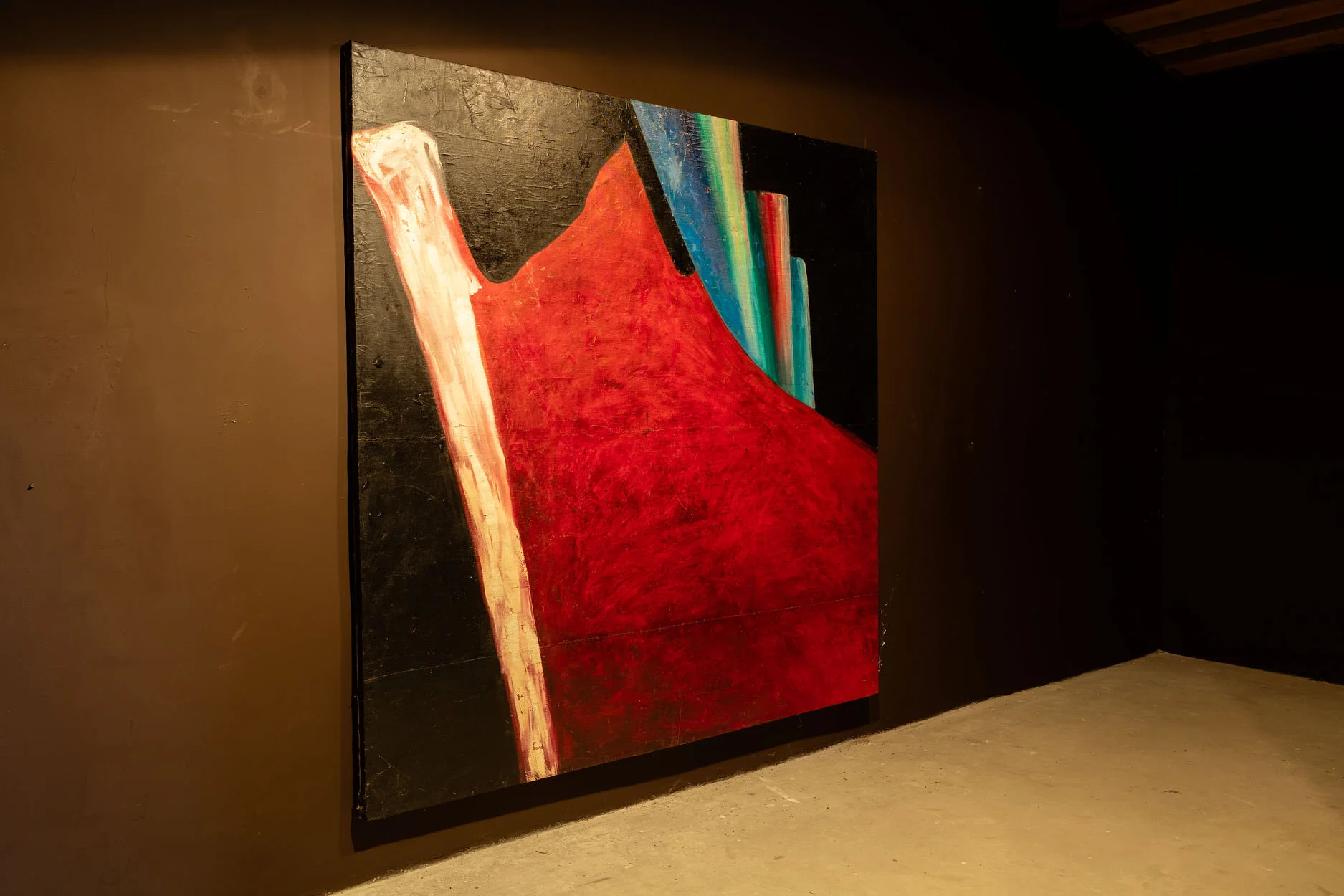
From June 5, 2021, the exhibition continues in the gallery “ChervoneChorne” Oleksandra Babaka“30 years later — the Necropolis Project”. It shows part of the 1991 exhibition “Necropolis” at NAMU (a joint project with Oleksandr Boroday). This is a story about the village of Leikov in Poltava region, which in 1990 was liquidated, while people left it 40 years before the official “burial”. Babak continued to work on the theme of Leikov in the future, so the image of the “dead” village unfolds before the audience, which is still nourished by art.
At the closing of the X Kanevsky International Sculpture Symposium on October 9—10, the plastic works of this year's symposium participants — Alexander Dyachenko, Vasyl Korchovy, Ilya Novgorodov, Vitaly Protoseni and Zdravkov, will be integrated into the exhibition of Alexander Babak.
We tell you what impressions can be expected from the exposition.
The author of the text is Polina Limina.
For the most part, people are afraid of abandoned villages and cities, which still have fresh memories of civilization, but nature has already managed to show its superiority. The trees sprouting through the houses; the unrecognizable outlines of the streets that have become thickets; the wild animals that have become the true masters of the free territory - all this not only reminds us of scenes from dystopias, but also underscores the importance of man to the environment in general. Especially when our eyes in an abandoned house come across signs of familiar and emotionally warm life: an exquisite service that could be delivered for the holidays, or a children's toy that had every chance of being loved. While everything around testifies to the incredible fragility of the framework of our usual life — in just a few years the ceiling, walls and floor will begin to crumble and deform under the action of natural forces.
At the same time, the complex emotions of abandoned settlements beckon us to them. After all, they are capable of evoking not only existential horror, but also nostalgia, fascination with nature, exploration enthusiasm or creative exaltation. The ruins of human existence act as a cemetery, a museum, a laboratory, and a therapy session. It is an opportunity to communicate with humanity and oneself in the absence of living people around — only in the realm of their images and ideas.
And places of real human decline and natural flourishing are increasingly becoming unique in the modern world. It is difficult to reach them — you need to find directions and information, drive off-road, and sometimes (as in the case of the Chernobyl Zone) take risks regarding the legality of actions or your own safety. All the more valuable becomes the experience of being in the middle of ruins. And all the more organically it turns into an art form.
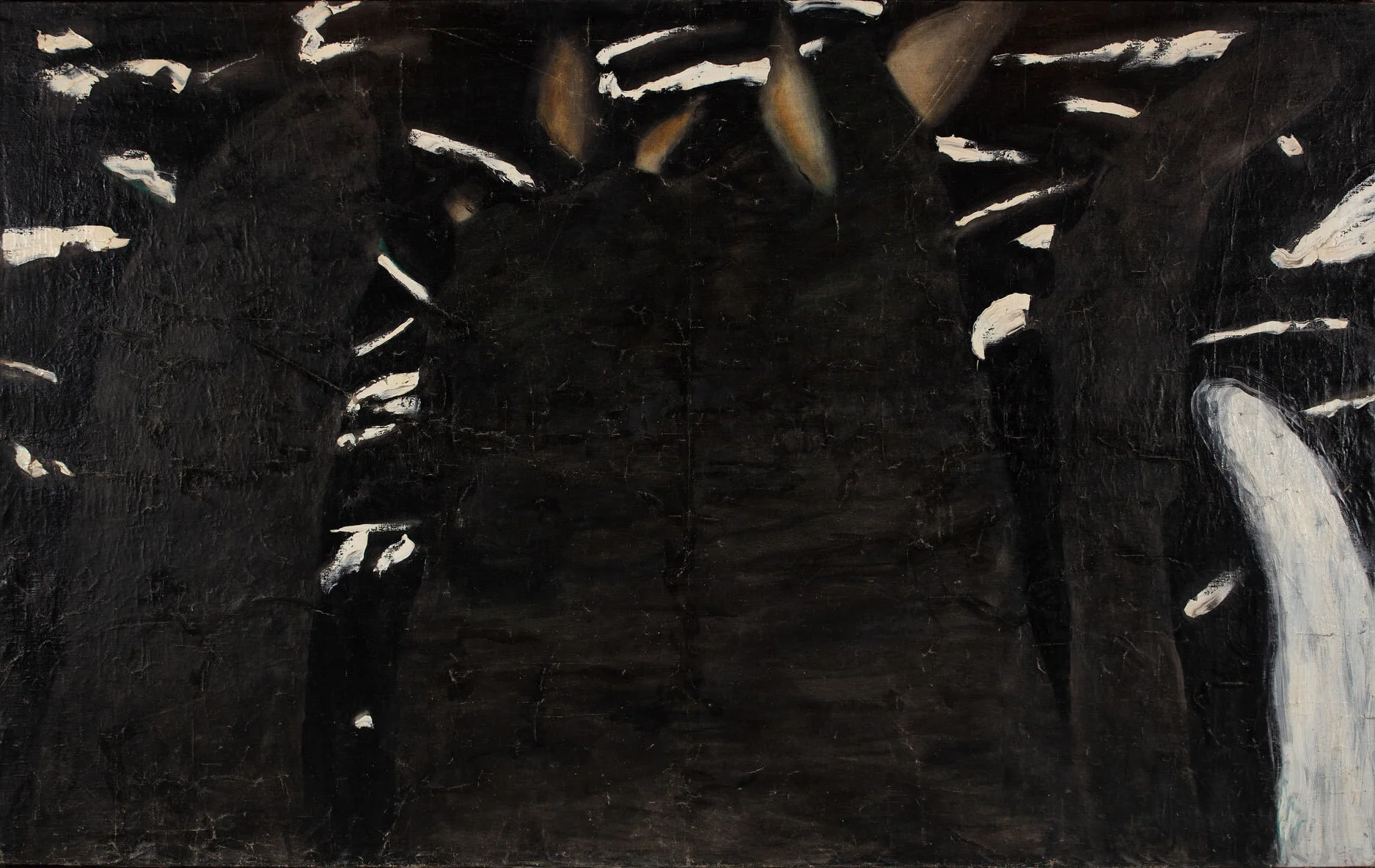
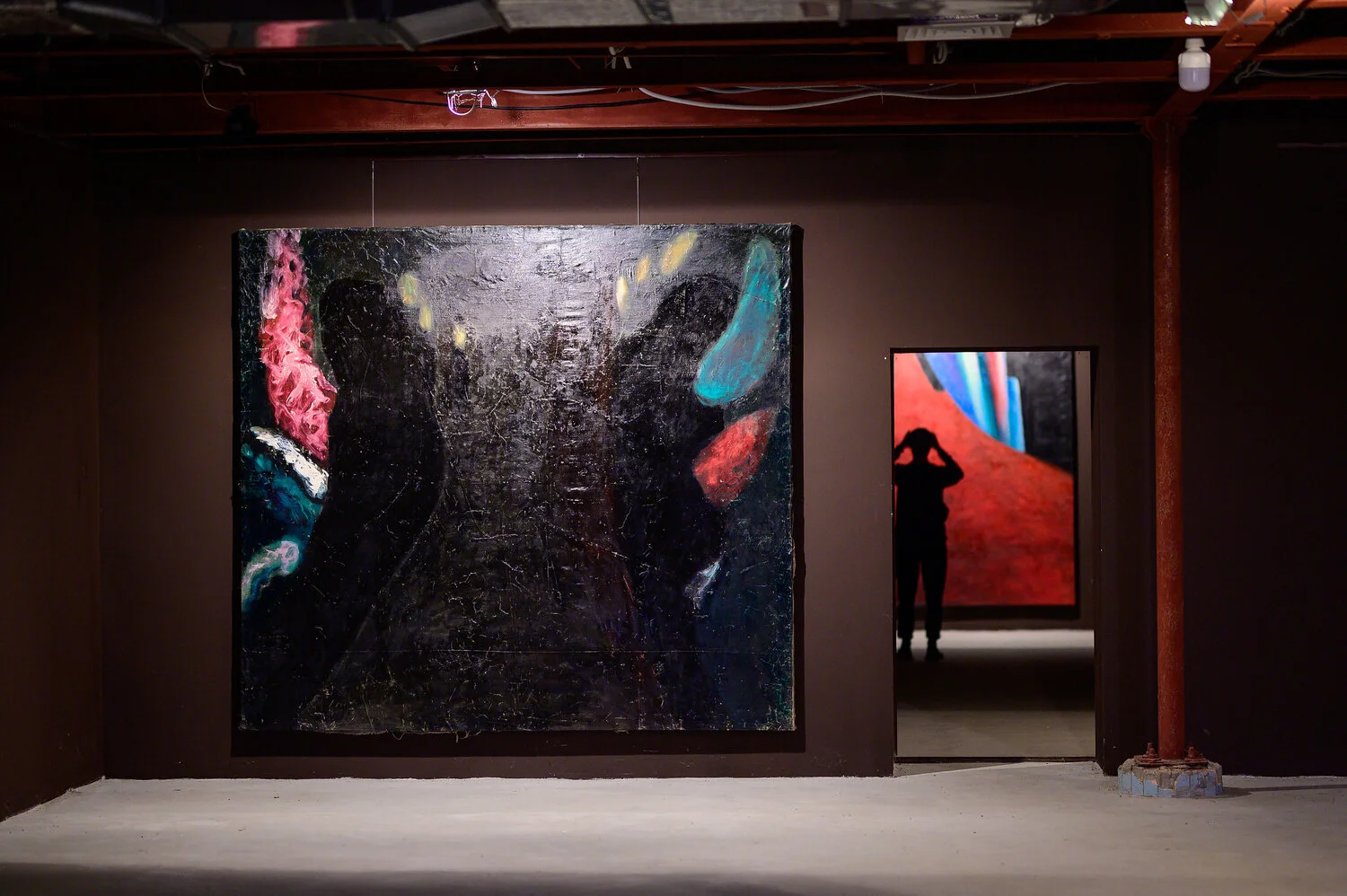
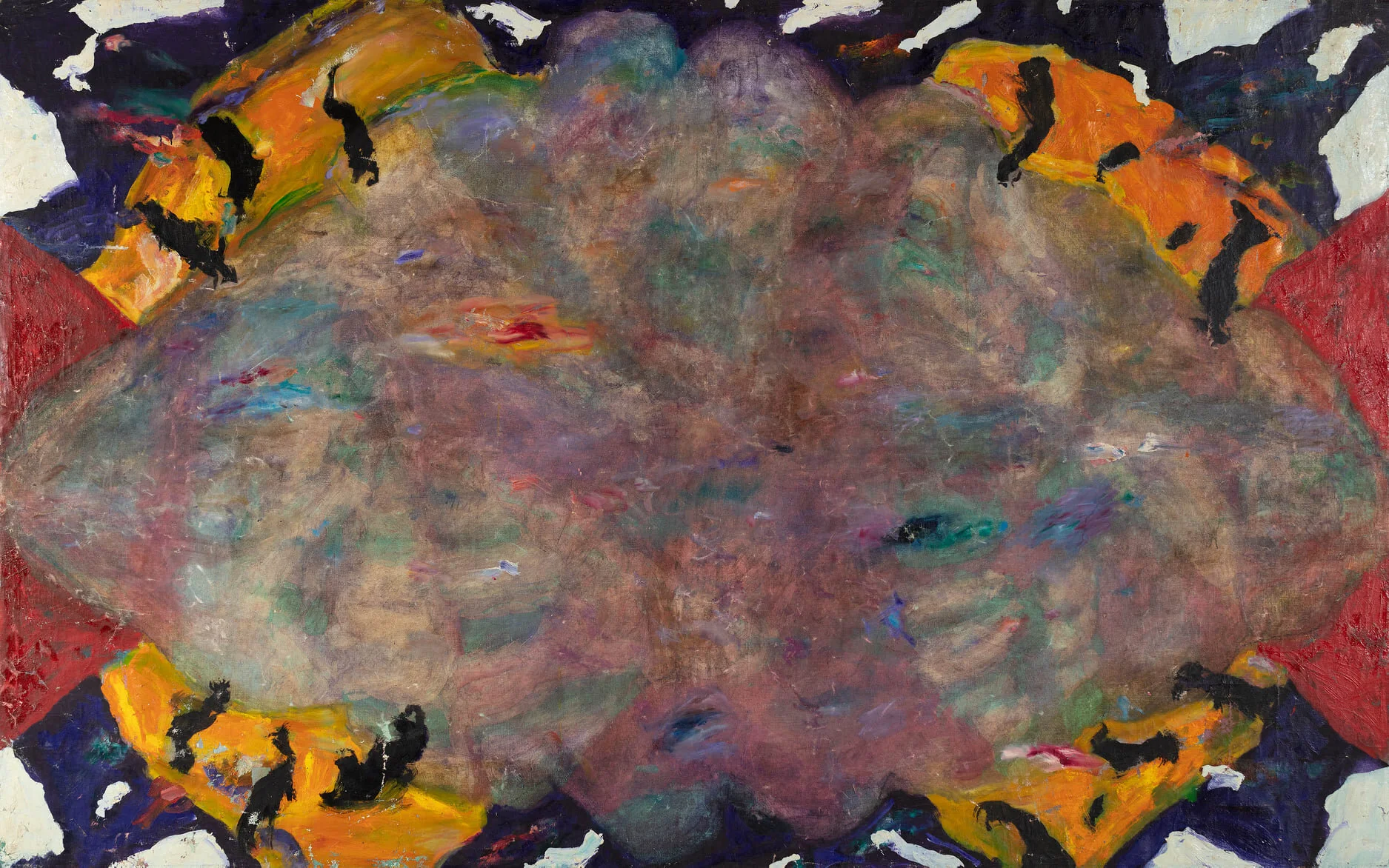
In Alexander Babak's large-scale (several meters) canvases from the Necropolis series, all these complex and somewhat contradictory sensations of ruins are thrust upon the viewer in several waves. At first, dark and saturated massive images (sometimes with a dominant and powerful blackness) evoke the same horror and powerlessness. After the first desperate explosion, more subtle and balanced emotions appear. Dull halftones bring you closer to peace, nature, your own consciousness. They encourage us to stop and realize the emptiness that exists around and within us. This effect is enhanced by the dim lighting of the Red Black Gallery, in which the eye is not distracted by anything but paintings. As well as the calm and unobtrusive nature around the gallery building is calm and unobtrusive: the sandy coast of the Dnieper with a smooth and inaccessible horizon line on one side, the slopes of green cliffs on the other.
Babak's Necropolis depicts and explores the specific Ukrainian village of Lakiv in Poltava region, although these images are appropriate to talk about any other abandoned settlement. However, in order to understand the work of Alexander Babak, it is important to understand how significant the physicality, reality and topographic reality of each theme for which he takes up becomes for this artist. Yes in the series “Local”(2015—2017) the artist observes only one small street of Dniprovska in Kanev. In the project “River”(2019) Babak records in the smallest detail a two-day journey through the Dnieper: assemblages on sails, geometry of bridges, captain's figure, unchanging perches on the horizon. If the artist makes still lifes (as in “Still Life”2017) or portrait (as in the book about the father “Petro Babak”, also an artist), all images still continue to be fixed in locations, in three-dimensional coordinate space — on the streets, in buildings, cities and villages that are important to the author. The fourth coordinate of time begins to seem not so important when compared with the value of the place. Thus, attention to one village, which has disappeared since the time of people and is already developing as a canvas for the timeless forces of nature, captivates with the consistency and depth of Alexander Babak's creative methods.
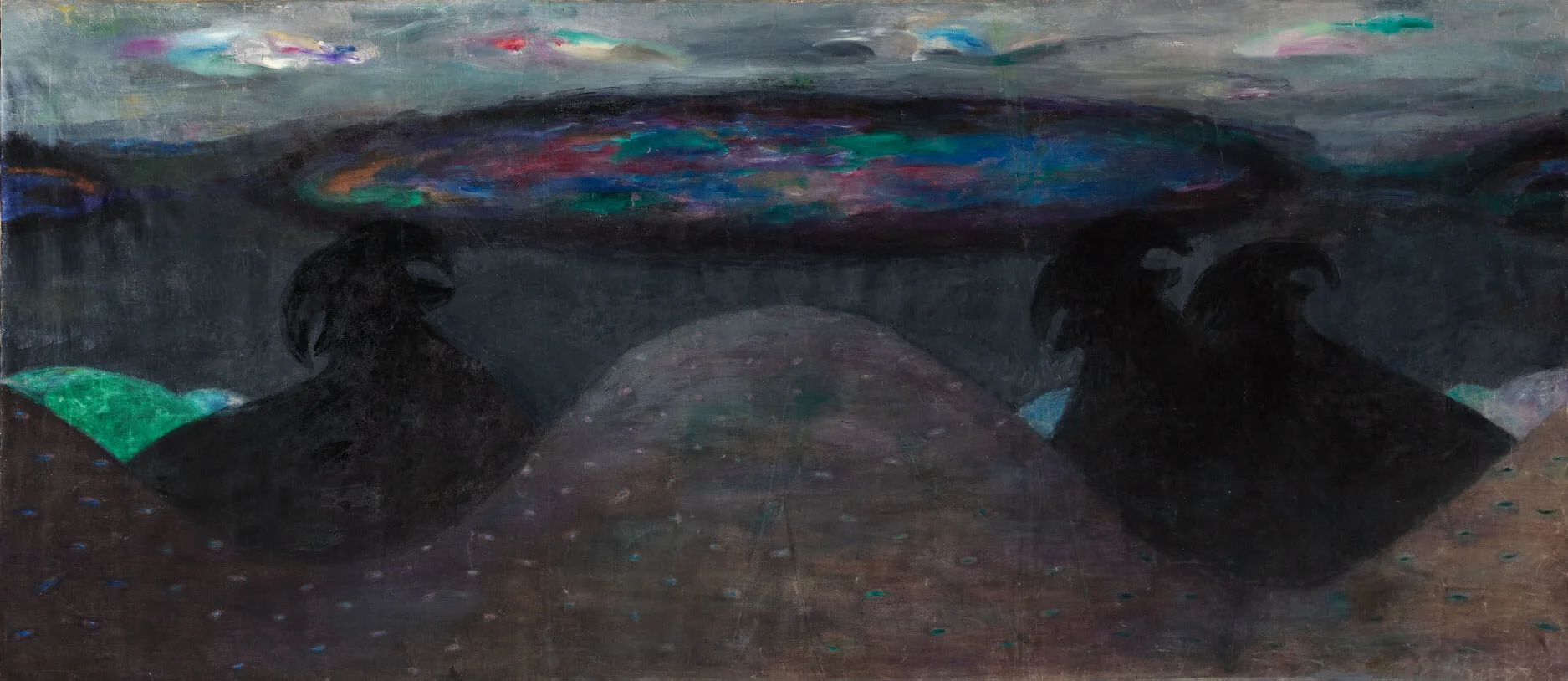
It is interesting to note that for the “Necropolis” of Babak it does not matter, why people left the village of Lakiv or how the liquidation of settlements takes place in the context of the state. The artist's canvases do not carry out anthropological work, do not broadcast social appeals or condemnations. They record moments, material things, physical properties. Oleksandr Babak worked on “Necropolis” in the 1990s, so today in the exhibition “Red Black” you can see paintings from the project. But during the creation, other artistic expressions were developed directly in Lake: installations from parts of houses, furniture and inventory, involvement of former local residents in the process, processing old photographs of residents. So some of Leikov's physical pieces have been reworked into art not metaphorically, but quite literally.
Although Leikov's “art-making” project is called “Necropolis”, in mood it makes little reference to archaeology or the researcher's detached contemplation. After all, first of all, it shows the proximity of a “dead” settlement to each of us - something at the level of fears, or a way to slow down and jump out of the urban noise into a timeless space of peace and silence.


.svg)